If you’ve ever gotten a text that just says “WTV” and wondered whether the person is annoyed, bored, or totally fine, you’re not alone. This tiny abbreviation carries a surprising amount of emotional weight, and figuring out exactly what someone means by it can feel like decoding a mood ring.
WTV is one of the most common pieces of digital shorthand you’ll come across in texts, DMs, gaming chats, and comment sections. It looks simple on the surface, but its real meaning shifts depending on who’s saying it, when, and how. This guide breaks down everything you need to know: the definition, the history, the emotional undertones, real-life examples, and how to respond when someone drops it on you.
What Does WTV Mean in Slang?
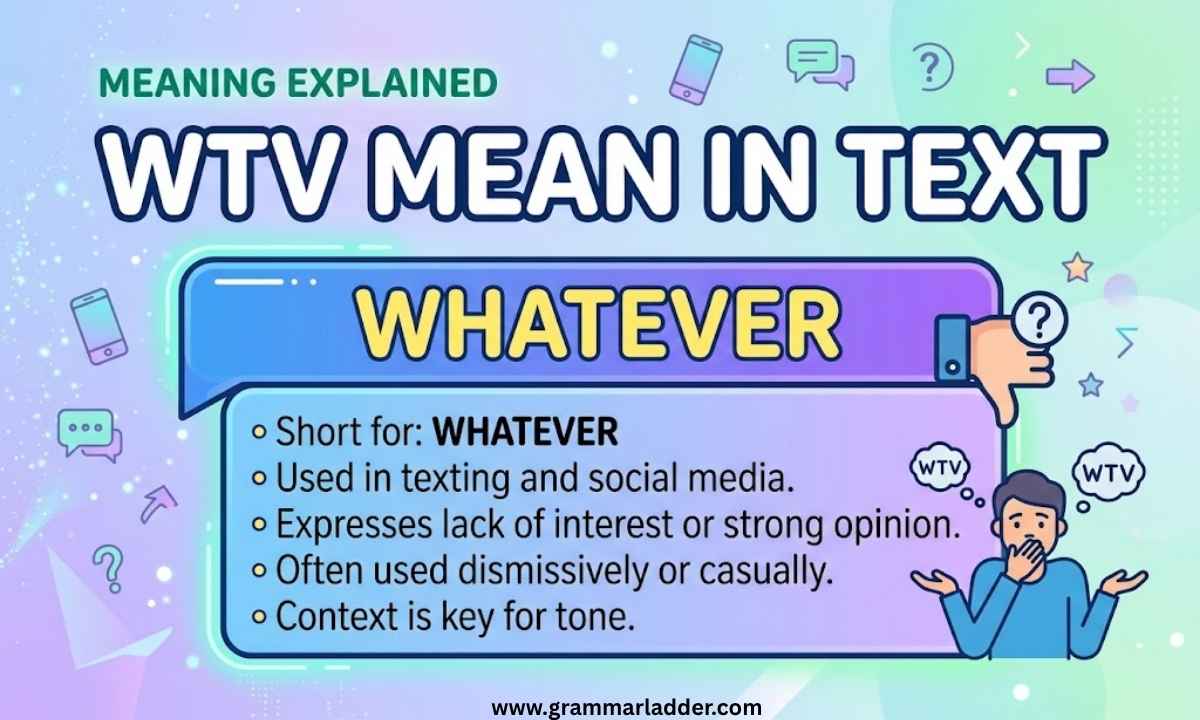
WTV is a texting abbreviation for “whatever.” That’s the short answer. It’s used to shorten one of the most versatile words in the English language into three quick letters that are faster to type and just as loaded with meaning.
Simple Definition
At its core, WTV means “whatever” — a word used to express indifference, agreement without enthusiasm, mild annoyance, or a desire to end a conversation. It’s not tied to one single emotion; instead, it’s a flexible response that borrows its tone entirely from context.
Why Is “WTV” So Popular?
Texting culture rewards speed. People want to communicate quickly without losing the emotional punch of a full sentence, and WTV does exactly that. It fits into the same family as other clipped expressions like “idk,” “nvm,” or “k,” all of which trade a few extra keystrokes for instant, low-effort communication.
Its popularity also comes from how universally relatable “whatever” is. Almost everyone has used the word to shrug off a disagreement, brush aside a comment, or simply say “I don’t mind either way.” Shrinking it to three letters made it even easier to drop into fast-paced conversations across texting apps, social platforms, and gaming chats.
Origin and History of WTV
The word “whatever” itself has a long history. Language researchers trace dismissive uses of “whatever” back to phrases like “what will be” from as early as the 19th century. But the version we know today — the eye-rolling, conversation-ending “whatever” — really took off in the 1980s and 1990s, becoming a defining phrase of teen culture and pop media at the time.
When mobile texting exploded in the early 2000s, character limits and slow keypads pushed people to abbreviate everything. Since “whatever” was already a go-to word for shutting down an argument or expressing apathy, shortening it to WTV was a natural next step, following the same logic that gave us LOL, BRB, and TTYL.
The Emotional Meaning Behind “WTV”
This is where WTV gets interesting. The same three letters can mean five completely different things depending on tone, punctuation, and relationship context.
Neutral or Chill
Used when someone genuinely has no strong preference. Example: “Pizza or burgers tonight?” — “WTV, both sound good.”
Dismissive or Uninterested
Used to signal that the topic doesn’t matter enough to keep discussing. It shuts a conversation down without extra explanation.
Frustrated or Annoyed
Often paired with short replies or left on read afterward. This version usually follows an argument or repeated nagging.
Sarcastic or Passive-Aggressive
Sometimes WTV is used to mock or dismiss what someone just said, especially when it follows an eye-roll-worthy comment.
Accepting or Letting Go
A softer version where someone is consciously choosing not to fight about something, more like “fine, let’s move on” than genuine anger.
How to Use WTV in a Sentence?
Casual Texting
“Are we still on for tonight?” “WTV works, I’m flexible.”
Social Media Comments
“This trend is so overrated.” “WTV, I still like it lol.”
Gaming Chat
“You went the wrong lane again.” “WTV man, let’s just win this round.”
Teen Conversations
“Mom said we can’t go out tonight.” “WTV, we’ll just hang at home then.”
Relationship Conversations
“I thought we agreed on this already.” “WTV, forget I brought it up.”
WTV Slang Meaning Urban Dictionary
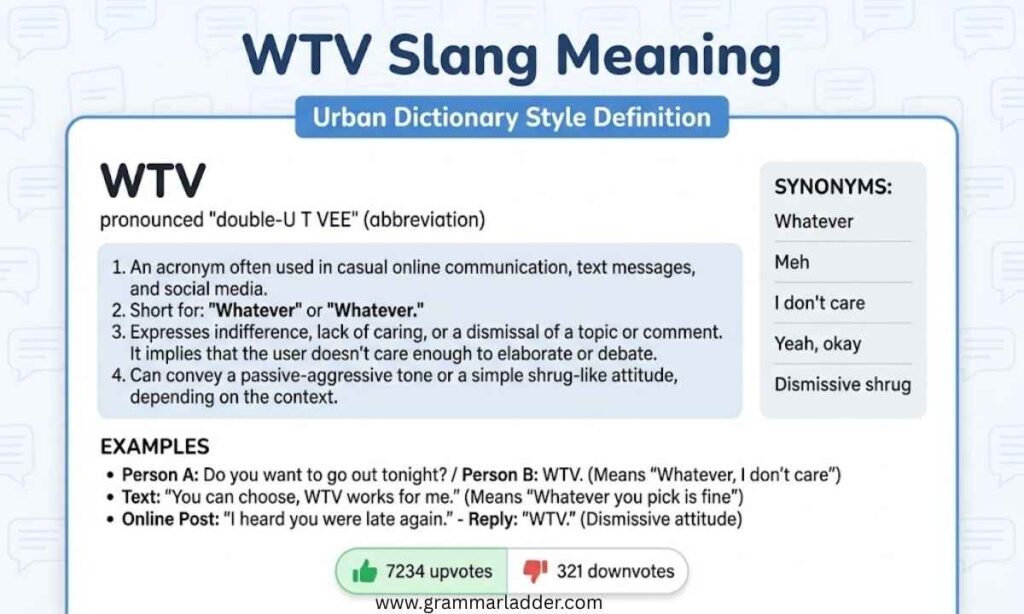
Crowdsourced slang dictionaries generally define WTV the same way most texters use it in real life: a shorthand for “whatever” that expresses indifference or a lack of interest in continuing a topic. User-submitted definitions often emphasize its dismissive edge more than its neutral use, since people tend to look up slang terms right after receiving them in a slightly tense conversation.
WTV Meaning Medical
Outside of texting, WTV isn’t a standard medical abbreviation, but it does occasionally appear in niche contexts such as veterinary or research notes as a stand-in for terms specific to that field (varying by document and institution). If you’ve seen WTV in a medical or clinical document rather than a text message, it’s best to check that specific source or professional, since the meaning has nothing to do with the texting slang.
What Does WTV Mean From a Boy?
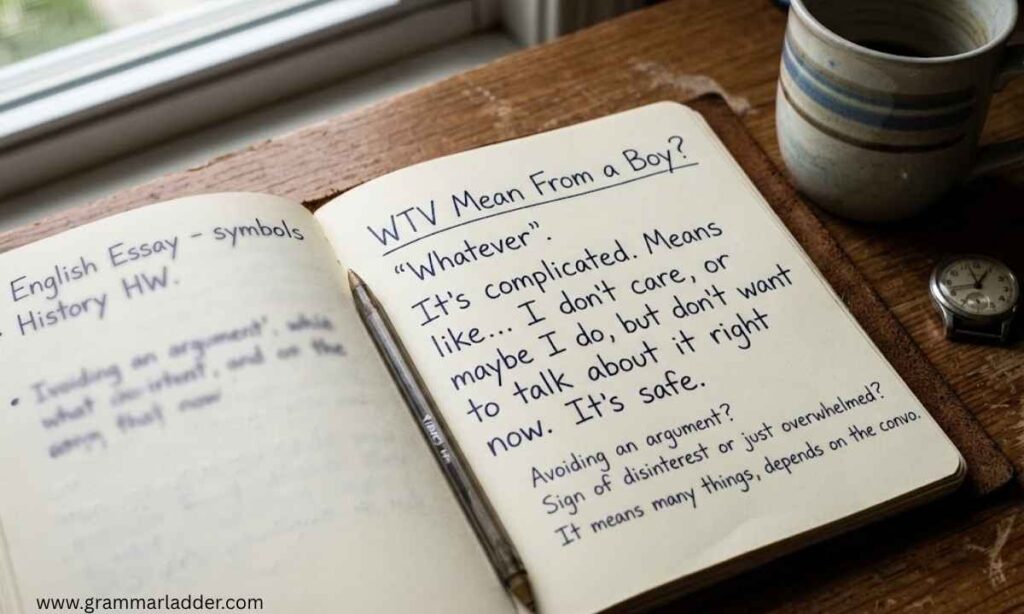
There’s no gender-specific meaning behind WTV — it means the same “whatever” regardless of who sends it. That said, when a guy sends a short, dry “WTV” with no follow-up, it’s often read as mild annoyance or disengagement, especially if it comes after a disagreement or a question he didn’t want to answer directly.
What Does WTV Mean From a Girl
The same rule applies here: the word itself doesn’t change based on gender. Context and tone still do all the work. A quick, cheerful “wtv, sounds good!” reads as easygoing, while a blunt “WTV.” with a period and nothing else usually signals irritation.
WTV Meaning in Text From a Guy
When guys use WTV in text, it’s frequently a low-effort way to end a back-and-forth without escalating it further. It can mean genuine indifference, but it can also be a way of avoiding a deeper conversation he doesn’t want to have right then.
What Does WTV Mean in Roblox
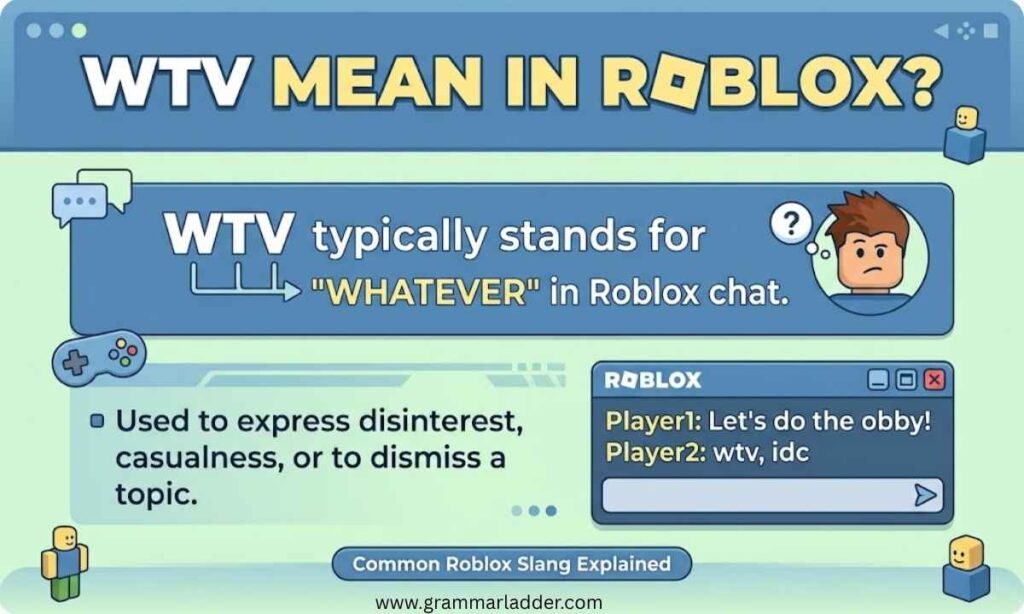
In Roblox chat and other gaming spaces, WTV is used exactly like it is in regular texting: “whatever.” Players use it to brush off a mistake, move past a disagreement about strategy, or simply say they don’t care which map or mode gets picked next.
WTV vs. Whatever: Is There a Difference?
| Aspect | WTV | Whatever |
| Format | Abbreviated, casual | Full word, more formal |
| Common platforms | Texting, gaming chat, social media | Spoken conversation, writing, texting |
| Perceived tone | Slightly more casual/lazy | Can feel more deliberate or emphatic |
| Speed | Faster to type | Takes a bit longer |
| Meaning | Identical | Identical |
There’s no real difference in meaning — WTV is simply a faster, more casual way of typing “whatever.” The main distinction is register: WTV feels more relaxed and is almost exclusively used in digital, informal spaces.
Common Variations and Related Slang
Variations
- wtv
- w/e
- whatevs
- wutever
Similar Slang Expressions
- idc – I don’t care
- nvm – Never mind
- k – A curt, low-effort “okay”
- meh – General indifference
- idk – I don’t know
When NOT to Use WTV
Avoid Using WTV In:
- Professional emails or workplace chats
- Conversations with someone you don’t know well
- Serious or emotionally sensitive discussions
- Customer service or formal communication
- Situations where clarity matters more than brevity
Using WTV in the wrong setting can come across as careless, rude, or dismissive — even if that’s not the intent.
Better Alternatives to WTV (Depending on Situation)
| Situation | Better Alternative |
| You genuinely don’t mind | “Either works for me” |
| You want to end an argument calmly | “Let’s talk about this later” |
| You’re busy and can’t reply properly | “Can we pick this up later?” |
| You disagree but don’t want conflict | “I see your point, let’s move on” |
Is WTV Rude?
WTV isn’t inherently rude, but it can easily come across that way. Because it strips away tone and explanation, the receiver often fills in the gaps with their own assumptions — usually leaning toward irritation or dismissal rather than a neutral read. Context, punctuation, and prior conversation history all shape how “rude” it feels.
How WTV Is Used Across Platforms?
Text Messages
Quick, casual replies to keep conversations moving without much thought.
TikTok Comments
Often used sarcastically to dismiss a take or brush off criticism.
Discord & Gaming Chats
Used to move past small mistakes or disagreements about gameplay decisions.
Instagram & Snapchat
Common in captions or replies to signal a laid-back, unbothered vibe.
Twitter/X Replies
Frequently used to shut down an argument or signal disinterest in continuing a thread.
Psychological Meaning Behind Saying “Whatever” or “WTV”
Psychologically, “whatever” often functions as an emotional shortcut. It lets someone disengage from a conversation without having to explain their feelings in detail. For some, it’s a genuine sign of low investment in the topic. For others, it’s a defense mechanism — a way to avoid vulnerability, conflict, or the discomfort of saying “I’m actually upset about this.”
WTV in Relationships & Friendships
In Romantic Relationships
WTV can be a red flag if it consistently replaces real conversation during disagreements. Repeated use during conflict often signals emotional withdrawal rather than actual indifference.
In Friendships
Between close friends, WTV is usually harmless shorthand for “I really don’t mind,” especially around low-stakes decisions like where to eat or what to watch.
WTV in School and Teen Slang
Among teens, WTV is a staple of everyday texting and group chats. It’s often used to sound unbothered in front of peers, even when the person actually does care — a reflection of how “whatever” became linked to teenage attitude decades ago.
Is WTV Appropriate in Professional Settings?
No. WTV should be avoided in emails, workplace Slack messages, or any communication with colleagues, clients, or supervisors. It reads as unprofessional and can unintentionally signal that you don’t care about the outcome of a conversation or task.
Common Misunderstandings About WTV
- Assuming it always means anger (it often doesn’t)
- Assuming it always means indifference (it can be sarcastic or hurt)
- Reading too much into punctuation without knowing the person’s texting style
- Treating it the same across every relationship, when context always changes the meaning
WTV vs. Similar Slang Abbreviations
| Abbreviation | Meaning | Typical Tone |
| WTV | Whatever | Varies (neutral to dismissive) |
| IDC | I don’t care | Often more blunt |
| NVM | Never mind | Ends a topic |
| MEH | General indifference | Low energy, unbothered |
| K | Okay | Can feel curt |
How to Respond to Someone Who Says “WTV”
Friendly or Neutral Context
Just move forward casually: “Cool, let’s do that then.”
Emotional or Conflict Situation
Gently check in: “Are you actually okay with this, or just saying that?”
Playful Context
Match the energy: “wtv yourself lol.”
WTV in Different Cultures and Languages
While WTV originated in English-language texting culture, the underlying attitude — a verbal shrug to express indifference — exists in many languages and cultures, often through their own slang equivalents. As texting slang spreads globally through social media, WTV itself has also been adopted informally by non-native English speakers in casual online conversations.
Why People Love Using WTV
- It’s fast and effortless to type
- It fits almost any casual conversation
- It lets people avoid over-explaining their feelings
- It works across platforms, from texts to gaming chats
- It carries just enough emotional nuance without needing extra words
What Does WTV Mean?
WTV is internet and texting slang for “whatever.” Its meaning shifts based on tone and context, ranging from genuine indifference to sarcasm, frustration, or quiet acceptance. It’s widely used in texting, social media, and gaming chats, but should be avoided in professional or serious conversations.
Frequently Asked Questions
What does WTV mean in a text message?
It’s short for “whatever,” used to express indifference, mild annoyance, or agreement without enthusiasm.
Is WTV the same as “whatever”?
Yes, WTV is simply a shortened, more casual way of typing “whatever.”
Is WTV rude to say?
It can come across as dismissive depending on tone and context, though it’s not inherently rude.
What does WTV mean from a girl or a guy?
The meaning doesn’t change by gender — context and tone decide whether it’s neutral or annoyed.
Can WTV be used in Roblox or gaming chats?
Yes, it’s commonly used in gaming spaces to mean “whatever” or “I don’t mind.”
Should I use WTV at work?
No, it’s too casual for professional emails or workplace conversations.
What’s a nicer alternative to WTV?
Phrases like “either works for me” or “let’s talk later” come across as more thoughtful.
Conclusion
WTV might look like a throwaway abbreviation, but it carries real emotional range. Whether it’s a laid-back “sure, doesn’t matter to me” or a sharper “I’m done talking about this,” the meaning always depends on the relationship, the conversation, and the tone behind it. Understanding that nuance is the difference between reading a text correctly and misjudging someone’s mood entirely — so next time WTV lands in your inbox, take a second to read between the lines before reacting.

John Marvel is a passionate writer with 4 years of experience exploring words and ideas. He runs an engaging blog focused on the meaning niche, where he dives deep into the origins, interpretations, and insights behind everyday terms. John loves making complex concepts simple and interesting for his readers. His curiosity drives him to uncover hidden stories and meanings that spark thought and conversation.