If you’ve been texting, DMing, or scrolling through group chats, chances are you’ve run into “WDYM” at some point — maybe as a genuine question, maybe as a dramatic reaction to something you just said. It’s one of those abbreviations that looks simple but carries a surprising amount of emotional range depending on who sends it and how.
This guide breaks down everything you need to know: what WDYM actually stands for, how its tone shifts across contexts, how it differs from similar texting slang, and how to respond when someone drops it on you.
What Does WDYM Mean in Text?
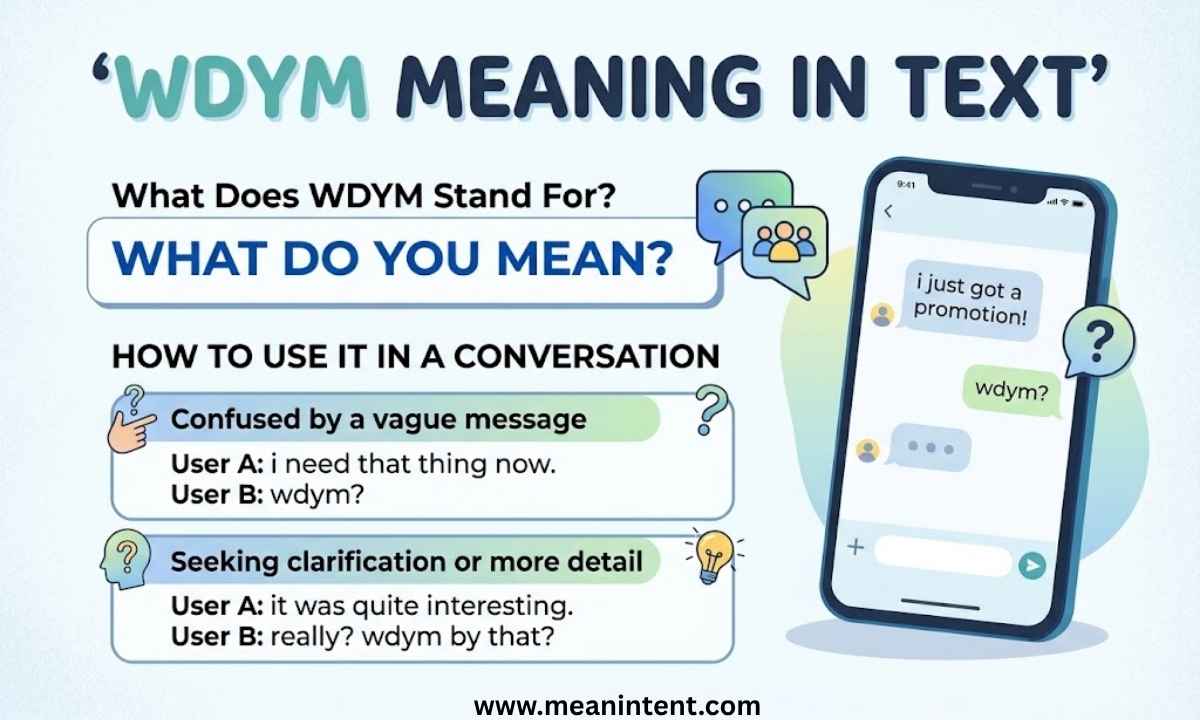
WDYM stands for “What Do You Mean?“ It’s a shorthand way of asking someone to clarify, explain, or elaborate on something they just said. Instead of typing out the full phrase, people compress it into four letters — a common move in fast-paced digital conversation where speed and brevity matter more than formality.
At its core, WDYM is a request for clarification. But unlike a plain “what do you mean?” typed out in full, the abbreviated version often carries extra flavor — sometimes curious, sometimes annoyed, sometimes teasing. The letters are the same; the emotional temperature behind them is not.
WDYM Most Common Uses at a Glance
| Use Case | What It Means |
| Genuine confusion | You didn’t understand what someone meant and want them to explain |
| Surprise or shock | Something unexpected was said and you’re reacting to it |
| Sarcasm or a challenge | You understood perfectly, but you’re pushing back or calling something out |
| Casual filler | Sometimes it’s just a reflexive response to keep a conversation moving |
How WDYM Is Used in Real Conversations?
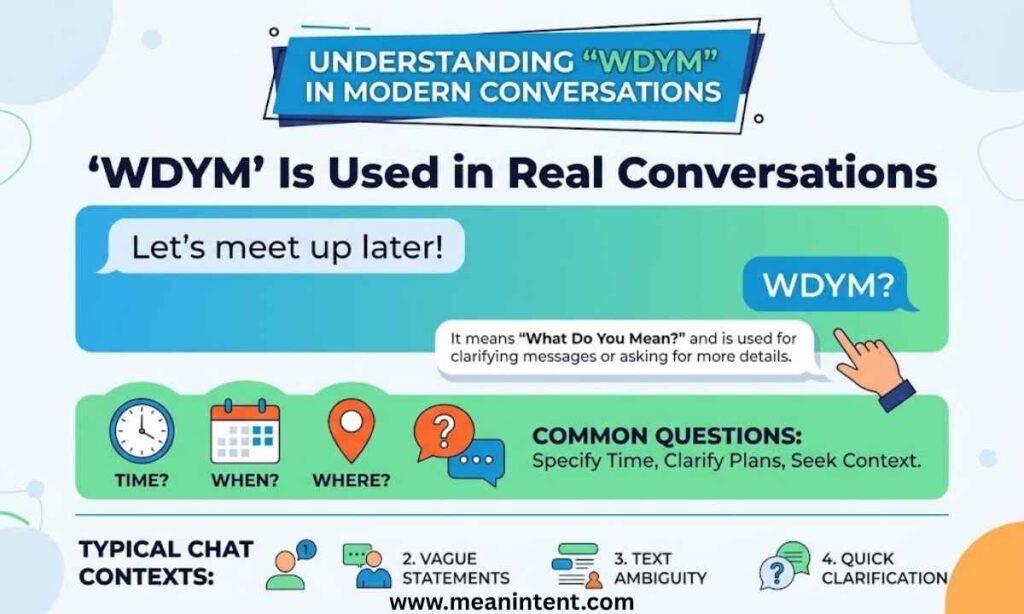
The same three letters can land completely differently depending on the context, punctuation, and relationship between the people texting. Here’s how it typically shows up.
WDYM for Genuine Confusion
This is the most literal use. Someone says something unclear, vague, or out of context, and the other person genuinely doesn’t follow.
Friend: “I can’t come tonight, it’s complicated.” You: “wdym complicated?”
Here, WDYM is doing exactly what it says — asking for more information so the conversation can move forward.
WDYM for Surprise or Shock
Sometimes WDYM isn’t about confusion at all — it’s a reaction. Someone drops unexpected news, and “WDYM” becomes a way of saying “wait, what?” or “no way, explain.”
Friend: “I got the job!” You: “WDYM you got it?? When did you even hear back??”
In this case, the person isn’t confused about the words — they’re processing surprise and want the full story.
WDYM in a Sarcastic or Challenging Tone
This is where WDYM gets its edge. When someone fully understands what was said but disagrees, feels defensive, or wants to call the other person out, WDYM becomes confrontational.
Friend: “You seemed kind of off today.” You: “wdym ‘off’? I’m fine.”
Here, the sender isn’t actually asking for clarification — they’re pushing back on an implication they didn’t like. Tone, capitalization, and punctuation (like extra question marks or all caps) usually signal this shift.
WDYM vs WYM — What Is the Difference?
WDYM and WYM are close cousins, and people often use them interchangeably, but there’s a subtle distinction:
| Abbreviation | Stands For | Typical Feel |
| WDYM | “What Do You Mean” | A direct, immediate reaction to something just said |
| WYM | “What You Mean” | A looser, even more casual variant — sometimes used the same way as WDYM, sometimes softer or more affectionate depending on the sender |
In practice, the difference is minor and mostly stylistic. WDYM tends to feel slightly more common and slightly more neutral, while WYM can feel a bit more casual or laid-back. Context matters more than the specific abbreviation.
The Tone of WDYM — Neutral to Confrontational
What makes WDYM tricky to interpret is that it sits on a spectrum:
| Position on Spectrum | What It Signals |
| Neutral end | Simple clarification, no emotional charge |
| Middle ground | Curiosity, excitement, or surprise |
| Confrontational end | Disbelief, defensiveness, or calling someone out |
Since text lacks tone of voice, people rely on cues like punctuation (“wdym??”), capitalization (“WDYM”), timing (an instant reply vs. a delayed one), and the emoji or lack thereof to figure out which end of the spectrum a message falls on.
WDYM Meaning in Text from a Boy
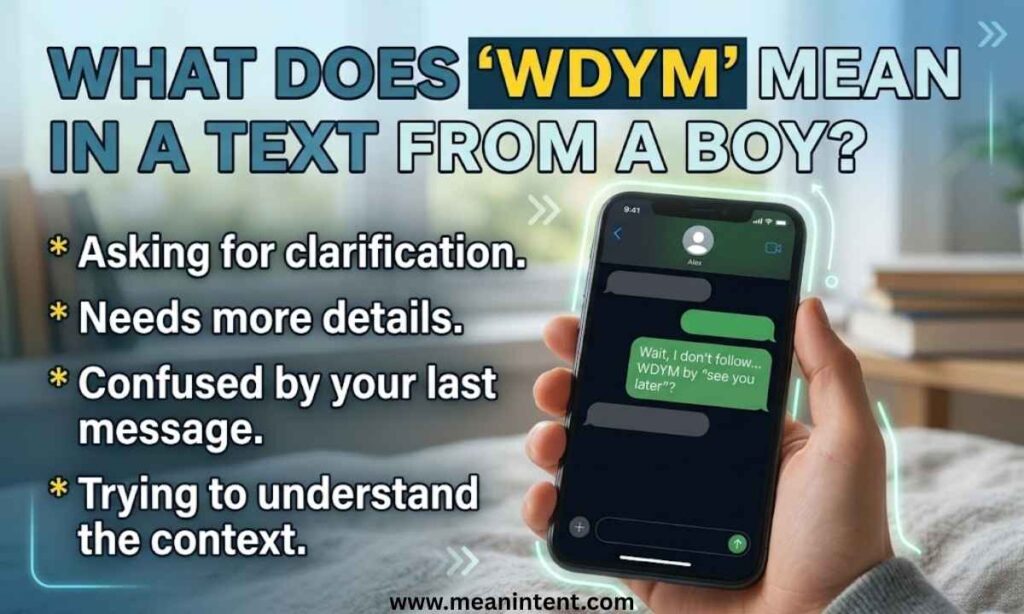
There’s no different “definition” of WDYM based on gender — the meaning stays the same. But in practice, when a guy sends “wdym” in a conversation (especially a flirty or emotionally loaded one), it often falls into one of these buckets:
- He’s genuinely unclear on something you said and wants more detail
- He’s reacting to something surprising or flattering (“wdym you like me back??”)
- He’s mildly pushing back on something that felt like an accusation or assumption
Reading it correctly comes down to the conversation’s context, not the sender’s gender.
WDYM Meaning in Text from a Girl
Same logic applies here. When a girl sends “wdym,” it can mean she’s asking a straightforward question, reacting with surprise to news, or gently challenging something that was said. The words don’t change meaning based on who typed them — the surrounding conversation does all the work.
WDYM Meaning in Chat
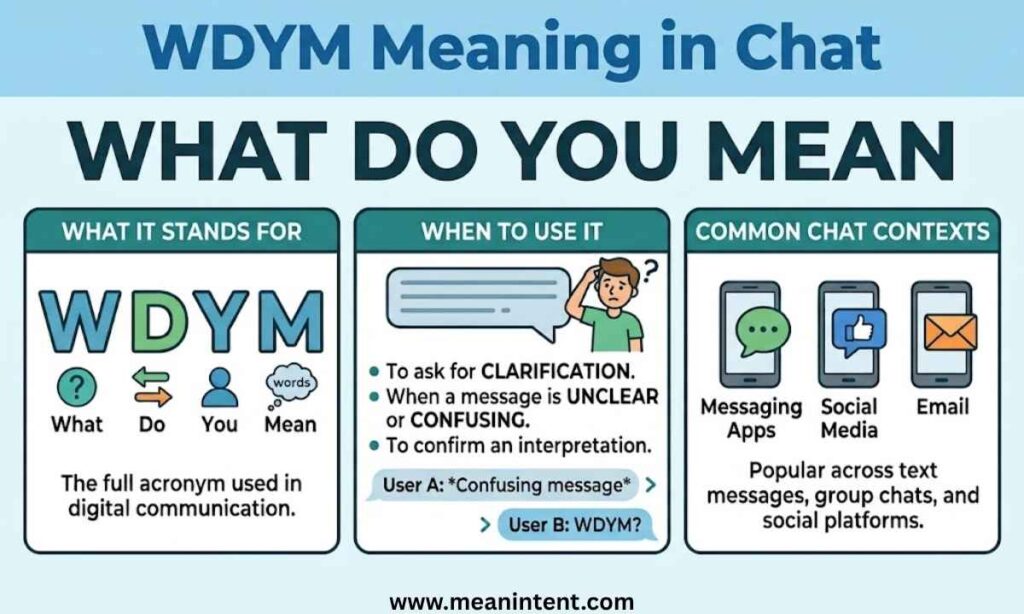
In broader chat contexts — Discord servers, group chats, gaming lobbies — WDYM often shows up quickly and casually, sometimes without much emotional weight at all. It can function almost like a verbal tic, a fast way to ask “explain that” without breaking the flow of conversation. In these settings, it’s usually closer to the neutral end of the tone spectrum.
How to Respond to WDYM?
If someone sends you WDYM, how you respond depends on reading the tone correctly:
| If It Seems… | How to Respond |
| Genuinely confused | Clarify calmly and directly. Restate your point with more detail or a simple example. |
| Surprised | Lean into it — give the fuller story or context they’re asking for. |
| Confrontational | Stay calm, don’t get defensive, and either explain your original point more clearly or ask them what specifically felt off. |
A good rule of thumb: when in doubt, respond as if it’s genuine confusion. Most WDYM messages aren’t meant as attacks, even if they read a little sharp on screen.
WDYM on Different Platforms
While the core meaning of WDYM stays consistent, its typical “vibe” can shift slightly by platform:
| Platform | Typical Vibe |
| Texting/iMessage/SMS | Personal, direct, often more emotionally loaded |
| Similar to texting, with added context from read receipts and delays | |
| Often public-facing, sometimes challenging or debate-oriented | |
| Snapchat | Casual, quick, low-stakes |
| Discord/gaming chats | Functional, fast, usually neutral |
WDYM in Gen Z Communication
For Gen Z texters, WDYM is a staple of everyday digital shorthand — used constantly, often without much thought, and frequently paired with other slang or reaction memes. It’s part of a broader communication style that favors compressed, efficient phrasing over full sentences, and that leans on context, timing, and platform norms to carry tone rather than explicit wording.
When to Use WDYM — And When Not To
Use WDYM When:
- You genuinely don’t understand something someone said
- You want a quick, casual way to ask for more detail
- You’re reacting to surprising or exciting news
- You’re texting in an informal setting where abbreviations are the norm
Never Use WDYM In:
- Professional emails or workplace Slack messages with people outside your close team
- Formal writing, cover letters, or academic work
- Sensitive or serious conversations where tone could easily be misread (e.g., conflict resolution, apologies)
- First-time conversations with someone you don’t know well, where the confrontational reading could land badly
When to Use WDYM – Quick Guide
| Situation | Good idea? |
| Casual text with a friend | ✅ Yes |
| Group chat banter | ✅ Yes |
| Reacting to surprising news | ✅ Yes |
| Work email to your boss | ❌ No |
| Serious relationship conversation | ⚠️ Use with caution |
| Comment on a stranger’s post | ⚠️ Can come off confrontational |
Frequently Asked Questions
Does WDYM always sound rude?
No. Most of the time it’s a neutral or even friendly request for clarification. It only reads as rude when paired with aggressive punctuation, all caps, or a dismissive tone elsewhere in the conversation.
Is WDYM the same as WYM?
They’re very close in meaning. WDYM (“What Do You Mean”) is slightly more common and neutral; WYM is a shorter, more casual variant often used the same way.
Can WDYM be used in professional settings?
Generally, no — it’s considered informal texting slang and isn’t appropriate for professional emails or formal communication.
How do I know if WDYM is genuine or sarcastic?
Look at punctuation, capitalization, timing, and the overall context of the conversation. Extra question marks, all caps, or a defensive topic usually signal a sharper tone.
Conclusion
WDYM is a small abbreviation with a surprisingly wide emotional range. At its simplest, it just means “what do you mean” — a request to clarify or explain. But depending on tone, platform, and context, it can express genuine confusion, excited surprise, or pointed pushback. The key to using and interpreting it well is paying attention to the conversation around it, not just the letters themselves. Once you get a feel for that context, WDYM becomes an easy, natural part of everyday digital conversation.

John Marvel is a passionate writer with 4 years of experience exploring words and ideas. He runs an engaging blog focused on the meaning niche, where he dives deep into the origins, interpretations, and insights behind everyday terms. John loves making complex concepts simple and interesting for his readers. His curiosity drives him to uncover hidden stories and meanings that spark thought and conversation.