If you’ve ever gotten a text that just says “FYI, the plans changed,” you already have a rough idea of what it means. But this tiny three-letter acronym carries more nuance than most people realize — it can be friendly, formal, sarcastic, or even a little cold, depending on who’s sending it and how.
In this guide, we’ll break down exactly what FYI means, where it came from, how it’s used across texting, email, and social media, and how to reply when someone sends it your way.
FYI – Quick Meaning
FYI stands for “For Your Information.” It’s used to share a fact, update, or detail that the recipient should know — without asking them to do anything about it or reply right away.
Simple Breakdown:
- F = For
- Y = Your
- I = Information
At its core, FYI is a heads-up. It tells the other person: “Here’s something you might want to know,” and nothing more is expected in return.
Quick Examples:
- FYI, the store closes at 9 tonight.
- FYI, I moved the meeting to Thursday.
- FYI, your package was delivered an hour ago.
Each of these examples shares a fact and stops there — no question, no request, no follow-up required.
Origin & Background
Where it came from:
FYI didn’t start on smartphones. It has roots in early 20th-century written communication, where short, clipped phrases were prized because space and time were limited. Wire services and telegraph operators are widely credited with popularizing it, since telegraph messages were charged by the word and every character saved mattered — usage is traced back to around 1915. Some accounts also tie its early use to office memos and internal business correspondence, where a quick tag was needed to flag non-urgent updates.
How it evolved:
As offices adopted typewriters, memos, and eventually email, FYI became a standard prefix for passing along information without demanding action. It picked up serious momentum once email became mainstream in the late 1980s and early 1990s, since it let people share quick updates without writing lengthy explanations. From there, it jumped into instant messaging, texting, and now lives comfortably in DMs, group chats, and social captions.
Real-Life Conversations (How People Actually Use FYI)
Seeing FYI in action makes its tone much easier to understand than any dictionary definition.
1. WhatsApp Chat
Sara: FYI, I’ll be 15 mins late; traffic is bad
Mia: No worries, take your time!
2. Instagram DM
Jake: FYI, I reposted your story; hope that’s cool
Ana: Yes, of course! Thank you
3. Office Email Style (Text Message Version)
Manager: FYI — the client pushed the deadline to Friday. No action needed from you yet.
4. TikTok Comments
User1: FYI, this hack doesn’t work on curly hair; tried it 3 times
User2: Thank you for the warning lol
Notice how the tone shifts slightly in each — casual with friends, neutral at work, and sometimes cheeky in comment sections.
FYI: Mean in Text From a Guy
When a guy texts “FYI,” it’s usually straightforward — sharing a plan, a fact, or a small update. It rarely carries romantic weight on its own. However, context matters: FYI paired with personal details (“FYI, I thought about you today”) can soften into a casual, low-pressure way of sharing feelings without seeming too intense.
FYI Meaning Rude
Can FYI sound rude? Yes, depending on tone and context. When used to correct someone publicly, point out a mistake, or precede criticism (“FYI, that’s not how you’re supposed to do it”), it can come across as blunt, condescending, or passive-aggressive. The acronym itself is neutral, but pairing it with corrective or critical statements often reads as sharp rather than helpful.
What Does FYI Mean From a Girl?
Similarly, when a girl uses FYI, it’s typically just an efficient way to relay information. It can occasionally signal mild defensiveness or a subtle “just so you know” tone, especially in a disagreement, but on its own it’s neutral. The emotional weight almost always comes from the sentence that follows FYI, not the acronym itself.
What Does FYI Mean in Email?
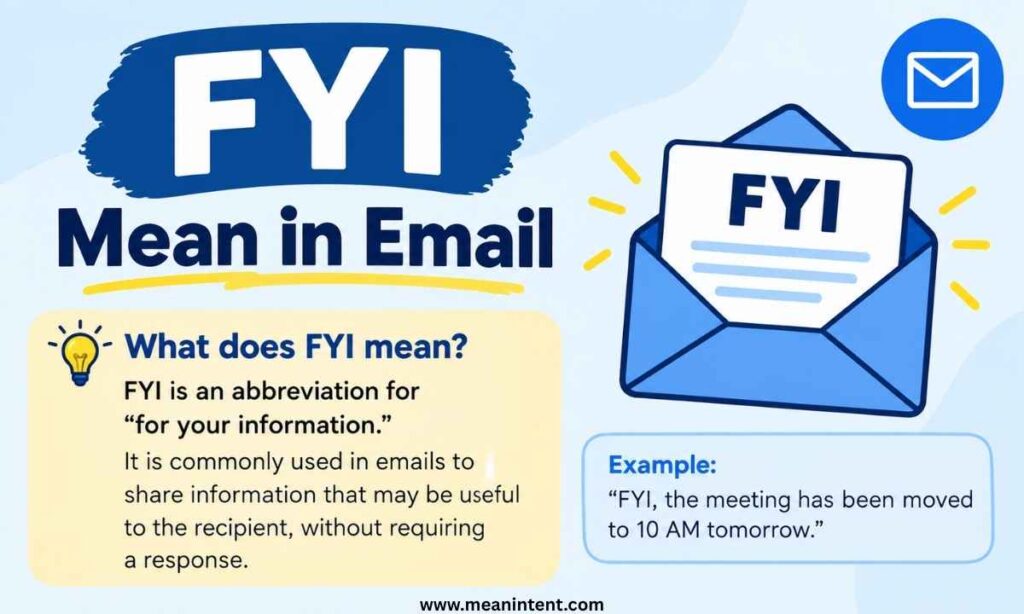
In professional email, FYI usually appears in one of two ways:
- As a standalone opener: “FYI, the report is attached.”
- In the subject line or as a forwarding note when looping someone in on a thread: “FYI – forwarding for your records.”
In workplace settings, FYI signals that no response or action is expected — it’s purely informational, which helps recipients quickly prioritize their inbox.
Emotional & Psychological Meaning
Behind its casual tone, FYI often reveals a little about the sender’s intent, mood, or communication style.
What it often signals:
- Efficiency — the sender wants to be brief
- Detachment — the sender may be keeping emotional distance
- Politeness — a soft way to introduce information without demanding a reaction
- Occasionally, mild irritation or a subtle jab
Why people use it:
People reach for FYI because it lowers the pressure of a message. It signals “you don’t have to respond to this,” which reduces the back-and-forth of a conversation. It’s also a quick way to protect the sender — by saying “FYI,” they’ve done their part in informing someone, regardless of what that person does with the information afterward.
Usage in Different Contexts
The way FYI lands can shift quite a bit depending on where the conversation is happening.” Right under the “Usage in Different Contexts” heading, before
1. Social Media
On platforms like Instagram, TikTok, and X, FYI often appears in captions or comments to clarify something or add context the audience might have missed.
2. Friends & Relationships
Among friends, FYI is casual and light — used for logistics, small updates, or gentle warnings (“FYI, he’s in a bad mood today”).
3. Work or Professional Settings
At work, FYI is a tool for keeping people in the loop without triggering unnecessary replies, which helps cut down on inbox clutter.
4. Casual vs Serious Tone
The tone shifts entirely based on punctuation, emojis, and surrounding words. “FYI forgot to mention” feels playful, while “FYI.” on its own can feel curt or final.
Common Misunderstandings
“Even though FYI feels simple, a few assumptions around it trip people up more often than you’d expect.” right under the “Common Misunderstandings” heading, before the first sub-point.
1. Thinking FYI is always polite
It’s often neutral, but pairing it with blame or correction can flip the tone negative fast.
2. Assuming it requires a reply
FYI is specifically meant to close the loop, not open a new conversation thread.
3. Using it in emotional conversations
Dropping FYI into a sensitive or emotional discussion can feel dismissive, since it signals detachment rather than empathy.
4. Overusing it at work
Sending too many FYI messages can bury genuinely important updates, making colleagues tune them out.
Comparison Table
| Term | Meaning | Expects a Reply? | Common Setting |
| FYI | For Your Information | No | Text, email, social media |
| FYA | For Your Action | Yes | Workplace, task-based emails |
| ASAP | As Soon As Possible | Often yes | Urgent requests |
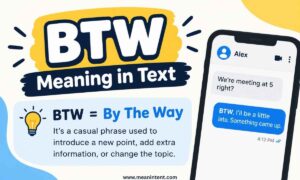
| BTW | By The Way | Optional | Casual conversation |
| NVM | Never Mind | No | Casual texting |
| PSA | Public Service Announcement | No | Group chats, social media |
Key Insight:
FYI is unique because it’s purely informational — unlike FYA or ASAP, it never implies urgency or a required response, which is exactly why it feels lower-pressure to both send and receive.
Variations / Types of FYI (Common Uses)
- Informational FYI – sharing a neutral fact (“FYI, it’s raining outside”)
- Warning FYI – a heads-up about a risk or problem (“FYI, that link looks suspicious”)
- Correctional FYI – pointing out an error (“FYI, you spelled that wrong”)
- Courtesy FYI – looping someone in out of politeness (“FYI, copying you on this thread”)
- Sarcastic FYI – used with a playful or pointed edge, often paired with emojis or tone markers
How to Respond When Someone Uses FYI?
“How you reply depends on the relationship and the tone of the original message — here are a few options for every situation.” Right under that heading, before
Casual Replies
- “Okay, thanks for letting me know!”
- “Got it “
Funny Replies
- “FYI received and filed away lol”
- “Noted, captain.”
Mature / Confident Replies
- “Appreciate the update.”
- “Thanks for the heads-up, I’ll plan around that.”
Private / Respectful Replies
- “Thanks, I’ll keep that between us.”
- “Understood, thank you for telling me directly.”
Regional & Cultural Usage
Western Culture
FYI is extremely common in both American and British English, used casually in texting and formally in office communication alike.
Asian Culture
In many Asian countries, English-based texting slang like FYI is widely adopted among younger, English-speaking, and professional communities, often blended with local language in messaging apps.
Middle Eastern Culture
FYI appears frequently in professional and bilingual chat contexts, particularly in business emails and WhatsApp groups that mix English with Arabic.
Global Internet Usage
Because English dominates internet culture, FYI has become nearly universal shorthand recognized across social platforms worldwide, regardless of a user’s first language.
Frequently Asked Questions
What does FYI stand for?
FYI stands for “For Your Information.”
Is FYI rude to use?
Not inherently — it depends on tone and context; pairing it with criticism can make it feel blunt.
Do I need to reply to an FYI message?
No, FYI messages are meant to inform, not to request a response.
Is FYI appropriate for professional emails?
Yes, it’s widely used and accepted in workplace communication.
What’s the difference between FYI and BTW?
FYI shares information formally or neutrally, while BTW (“by the way”) is more casual and conversational.
Conclusion
FYI may only be three letters, but it carries a surprising amount of flexibility. Whether it’s a quick heads-up between friends, a neutral note in a work email, or a subtle jab in a heated exchange, its meaning always comes down to context and tone. Once you understand how to read — and use — FYI correctly, it becomes one of the easiest ways to keep conversations efficient without sounding cold or robotic.

John Marvel is a passionate writer with 4 years of experience exploring words and ideas. He runs an engaging blog focused on the meaning niche, where he dives deep into the origins, interpretations, and insights behind everyday terms. John loves making complex concepts simple and interesting for his readers. His curiosity drives him to uncover hidden stories and meanings that spark thought and conversation.