If you’ve seen MYF pop up in a text, a Snapchat reply, or a comment under a TikTok, you’re probably wondering if you missed some kind of inside joke. You didn’t. MYF is just one of those short, punchy texting abbreviations that carries more than one meaning, and the right one depends entirely on who sent it and what you were talking about.
This guide breaks down every common meaning of MYF, where it came from, how people actually use it across different apps, and how to reply without sounding confused.
What Does MYF Mean in Text & Chat?
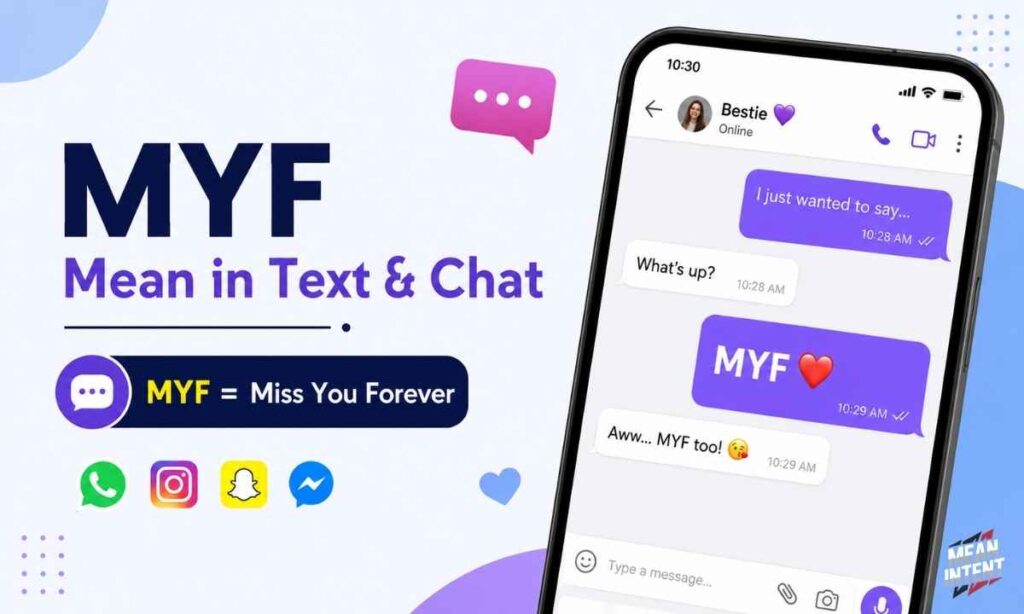
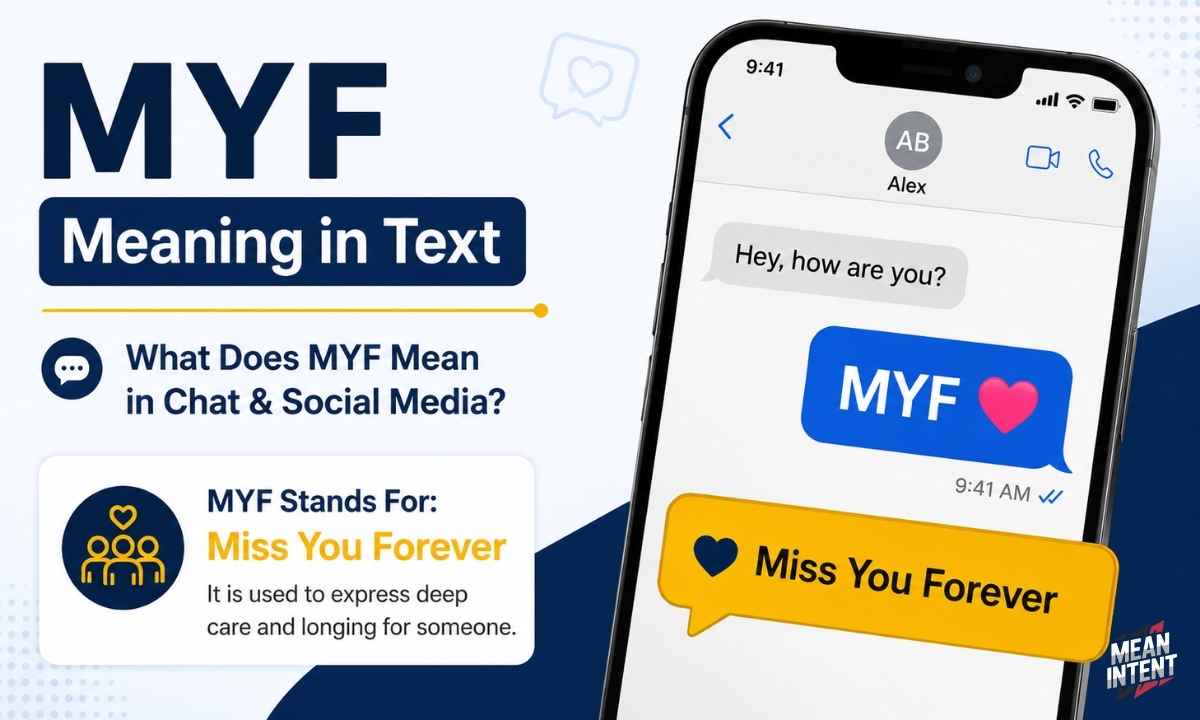
At its core, MYF is a texting abbreviation with several possible meanings, and the one that fits changes based on tone and context. The three most common interpretations are:
- Miss Your Face – a casual, affectionate way of saying you miss seeing someone
- My Fault – a quick, informal apology
- Mind Your F*ing Business** (often softened to “Mind Your Business”) – a blunt way of telling someone to back off
Because texting strips away tone of voice and facial expression, the same three letters can read as sweet in one conversation and sharp in another. That’s why context clues — emojis, punctuation, and the flow of the chat — matter more with MYF than with clearer acronyms like LOL or BRB.
Full Form, Stands For & Short Meaning of MYF
Here’s a quick-reference list so you can scan the possibilities at a glance.
- Miss Your Face — Warm, affectionate tone; used when talking to a close friend, partner, or family member
- My Fault — Neutral, apologetic tone; used for owning up to a small mistake
- Mind Your Business — Blunt, defensive tone; used for shutting down a nosy question
- Miss You Forever — Sentimental tone; used between long-distance friends or partners
- Miss You, Friend — Friendly tone; used for reconnecting with someone you haven’t talked to in a while
The takeaway: MYF doesn’t have one fixed “official” definition the way an acronym like ASAP does. It’s a flexible piece of internet shorthand, and the meaning is set by the conversation around it.
Origin, History & First Known Use of MYF
There’s no single documented “birth date” for MYF the way there is for older internet slang like LOL or BRB, which trace back to early chatrooms and instant messenger platforms in the 1990s. Instead, MYF appears to have emerged gradually as part of the broader wave of shorthand that grew alongside SMS texting and, later, mobile messaging apps.
A few points worth noting about its history:
- It follows the same abbreviation pattern as older phrases like “Miss You” (MY) that got extended once texting culture embraced longer emotional shorthand.
- Character limits on early SMS plans pushed people to compress full sentences into initials, and phrases about missing someone were prime candidates for shortening.
- Its “Mind Your Business” meaning likely grew out of spoken slang that was already common before it migrated into text form.
Because it developed informally across different friend groups and platforms rather than being coined in one specific place, MYF doesn’t have a single credited origin story — it’s a product of collective texting culture rather than one viral moment.
How Do People Use MYF in Daily Conversations?
In everyday texting, MYF usually shows up in one of three situations:
- Reconnecting after time apart — someone sends a throwback photo or memory and caps it with “MYF” to say they miss seeing the other person.
- A quick apology mid-conversation — used almost like “oops” when correcting a small error.
- Deflecting a nosy question — a short, sometimes joking way to end a line of questioning.
Most people type it in lowercase (“myf”) in casual chats, and it’s almost always paired with an emoji to signal tone — a heart or sad face for the affectionate meaning, a laughing emoji for the “mind your business” version.
MYF Meaning Across WhatsApp, Instagram, TikTok & Snapchat
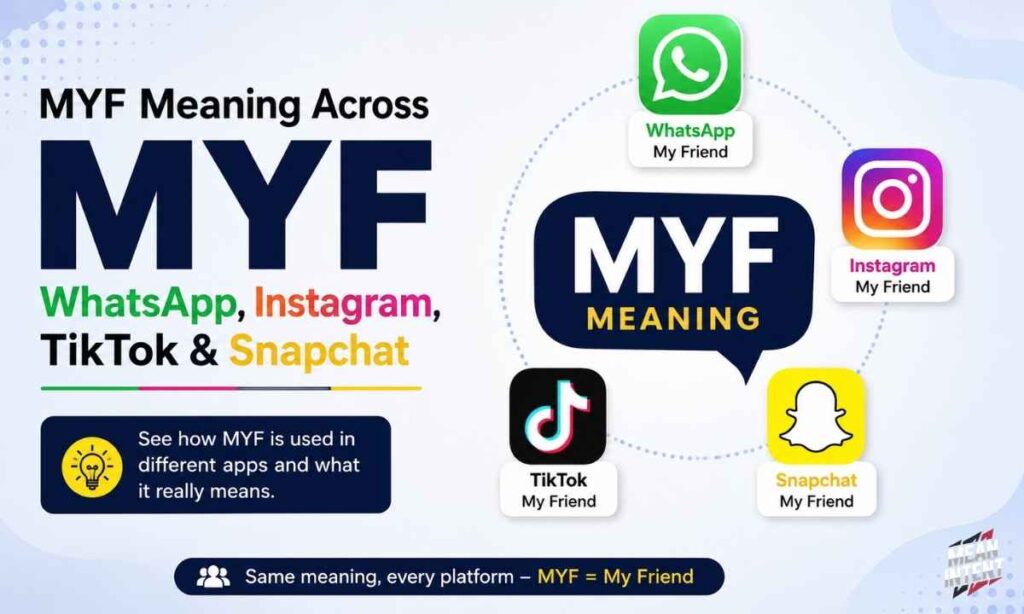
The meaning of MYF can shift slightly depending on the platform it’s used on.
- WhatsApp — Usually means Miss Your Face / My Fault; common in personal chats with friends or family
- Instagram — Usually means Miss Your Face; common in comments on old photos or throwback posts
- TikTok — Usually means Mind Your Business; common in comment sections and reply videos
- Snapchat — Usually means Miss Your Face; common in captions on memories or streak replies
On visually driven apps like Instagram and Snapchat, the affectionate “miss seeing you” meaning tends to dominate because the content itself (photos, memories) naturally supports that tone. On comment-heavy platforms like TikTok, the blunter “mind your business” meaning shows up more often, especially in back-and-forth banter between users who don’t know each other well.
Different Meanings of MYF in Other Fields
Outside of texting slang, MYF also stands for several unrelated things, so it’s worth knowing these to avoid mixing them up:
| Term | Field | Meaning |
| Muslim Youth Foundation | Community/Religious | A community organization name used by various mosques and youth groups |
| Myfanwy | Names | A Welsh given name, sometimes shortened informally to “Myf” |
| Montgomery Field | Aviation | The IATA airport code for a public airport in San Diego |
| MYF5 | Science | A gene/protein name used in biology and genetics research |
If you see “MYF” in a non-chat context — like a news article, an organization’s social media bio, or a scientific paper — it almost certainly isn’t referring to the texting slang at all.
Common Confusions, Mistakes & Wrong Interpretations
Because MYF has multiple meanings, misreadings happen often. Here are the most common mix-ups:
- Assuming it’s always romantic — MYF is frequently platonic, especially between friends.
- Assuming it’s always rude — the “mind your business” meaning is often playful rather than genuinely hostile.
- Confusing MYF with similar-looking acronyms like MF, YF, or MYO, which have completely different meanings.
- Missing the tone entirely because there’s no emoji or punctuation to hint at intent.
- Using it in professional or formal messages, where it can come across as unclear or unprofessional.
When in doubt, the safest move is simply to ask what the sender meant rather than guessing.
Similar Terms, Alternatives & Related Slang
MYF sits alongside a handful of other short texting phrases people use to express similar sentiments:
- MU — Miss You
- MYB — Mind Your Business
- IMY — I Miss You
- NBD — No Big Deal (similar spirit to “My Fault”)
- HMU — Hit Me Up
Knowing these related terms makes it easier to spot patterns in casual texting shorthand overall, not just with MYF specifically.
MYF Meaning in Text Discord
On Discord, MYF tends to lean toward the “mind your business” or “my fault” meanings more than the affectionate one. Server chats and gaming voice channels move fast, and blunt, quick reactions fit that pace better than sentimental messages. You’ll often see it dropped into a reply after someone gets called out for a mistake in-game, functioning almost like a shorthand shrug.
MYF Meaning in Text From a Girl
When a girl sends MYF, it usually leans toward the Miss Your Face meaning, especially in one-on-one conversations with a close friend or partner. It’s a soft, casual way of expressing that she misses seeing the other person, often sent after looking at old photos or during a lull in conversation. Context — like the rest of the message and any emojis used — still matters for confirming the tone.
MYF Meaning in Text from a Boy
From a boy, MYF can go either way depending on the friend group and conversation style. In more affectionate contexts, it still points to “Miss Your Face.” In group chats or banter-heavy conversations, it’s more likely to mean “Mind Your Business,” especially if it follows a joking question or a tease. As with any slang, the surrounding conversation is the real decoder.
MYF Meaning in Gaming
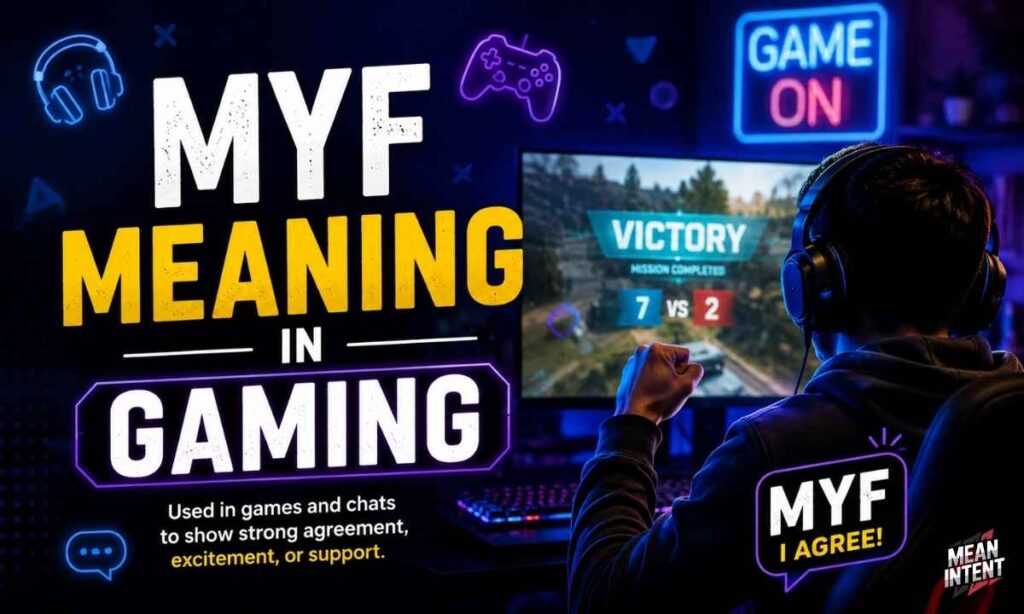
In gaming chats and voice lobbies, MYF is typically shorthand for “my fault,” used to quickly own a mistake without breaking the flow of the match — missing a shot, calling the wrong play, or messing up a strategy. It’s fast, low-drama, and keeps the game moving, which is exactly why gamers favor short acronyms like this one.
Examples of MYF Meaning in Text in Real Chat Situations
Here’s how MYF plays out in real conversations:
- A: “Found this old photo of us from last summer.” B: “Aw, MYF “
- A: “You sent that to the wrong group chat.” B: “Oh no, MYF lol”
- A: “Why didn’t you tell me about the party?” B: “MYF business tbh “
- A: “We missed you at the game night.” B: “MYF too, next time for sure”
- A: “That was the wrong file.” B: “MYF, sending the right one now”
Notice how the surrounding sentence, punctuation, and emoji all work together to make the meaning clear.
How to Reply When Someone Says MYF?
Not sure how to respond? Here’s a simple approach based on context:
- If it seems affectionate: Reply warmly — “Miss you too!” or a heart emoji works fine.
- If it seems like an apology: A simple “No worries” or “All good” keeps things light.
- If it seems like “mind your business”: You can laugh it off with “Fair enough ” or drop the topic entirely.
- If you’re genuinely unsure: Just ask — “Wait, what do you mean by MYF?” It’s a completely normal question and avoids awkward misreads.
Is MYF Still Popular? Trends & Online Usage?
MYF isn’t as universally recognized as staples like LOL, BRB, or OMG, but it remains in steady, moderate use — particularly among younger texters and social media users who favor compact slang. It shows up consistently in comment sections, DMs, and casual group chats, and its multiple meanings actually help keep it relevant, since it adapts to different conversational moods rather than being tied to one single use case. It’s not a fading trend, but it’s also not mainstream enough to appear in formal or professional contexts.
Quick Facts About MYF Meaning in Text
| Fact | Detail |
| Fixed meaning? | No single fixed meaning — context decides it |
| Most common meanings | Miss Your Face, My Fault, and Mind Your Business |
| Platforms used on | WhatsApp, Instagram, TikTok, Snapchat, and Discord |
| Non-slang meanings | Can refer to a name, an organization, an airport code, or a gene |
| Formal use | Too casual for professional or formal communication |
| Role of emojis | Play a major role in signaling which meaning is intended |
Frequently Asked Questions
What does MYF mean in a text from a crush?
It most likely means “Miss Your Face,” a casual and slightly affectionate way of saying they miss seeing you.
Is MYF rude?
Not usually — it can sound blunt, like “Mind Your Business,” but it’s typically playful rather than genuinely aggressive.
Does MYF always mean “Miss Your Face”?
No, it can also mean “My Fault” or “Mind Your Business” depending on the conversation.
Can I use MYF in a work email?
No, it’s too casual for professional or formal communication.
Is MYF common on all social media platforms?
It’s used across most platforms, but its meaning can shift slightly depending on where it’s used.
How do I know which meaning of MYF someone intended?
Look at the tone of the message, any emojis used, and the context of the conversation before assuming.
Is MYF the same as MYB?
No, MYB specifically means “Mind Your Business,” while MYF can mean several different things.
Conclusion
MYF is a small piece of texting shorthand that carries a surprising amount of flexibility. Depending on who sends it and what the conversation is about, it can mean anything from a heartfelt “I miss seeing you” to a lighthearted “my bad” to a blunt “stay out of it.” The key to reading it correctly isn’t memorizing one fixed definition — it’s paying attention to context, tone, and the emojis that usually ride along with it. Once you know the range of meanings, MYF stops being confusing and becomes just another quick, expressive tool in everyday digital conversation.

John Marvel is a passionate writer with 4 years of experience exploring words and ideas. He runs an engaging blog focused on the meaning niche, where he dives deep into the origins, interpretations, and insights behind everyday terms. John loves making complex concepts simple and interesting for his readers. His curiosity drives him to uncover hidden stories and meanings that spark thought and conversation.