In today’s digital world, abbreviations and internet slang have become a major part of online communication. One popular acronym you may have seen in text messages, social media comments, gaming chats, and memes is IMAO. If you’ve ever wondered about the IMAO meaning in text, you’re not alone. This slang term is commonly used to express opinions, humor, and sarcasm in casual online conversations.
This complete guide explains what IMAO means in text, its full form, history, usage across social media platforms, examples, and how Gen Z users incorporate it into their daily chats.
What Does IMAO Mean in Text & Chat?
In text messaging and online conversations, IMAO stands for:
“In My Arrogant Opinion”
It is a humorous or sarcastic variation of the popular abbreviation IMO, which means “In My Opinion.”
People use IMAO when they want to express an opinion while jokingly pretending to be overly confident, arrogant, or sarcastic. The phrase often adds humor and personality to a conversation.
Example:
Person A: Which superhero movie is the best?
Person B: IMAO, Spider-Man movies are unbeatable.
In this example, the speaker isn’t actually being arrogant; they’re using humor to emphasize their opinion.
Full Form, Stands For & Short Meaning of IMAO
- IMAO stands for “In My Arrogant Opinion.”
- It is a popular internet slang acronym used in texting and online chats.
- The term is usually used in a humorous or sarcastic way.
- IMAO is a playful variation of IMO (In My Opinion).
- People use it to express a strong opinion while jokingly acting confident or arrogant.
- It is commonly found on WhatsApp, Instagram, TikTok, Snapchat, Reddit, and Discord.
- IMAO is considered informal slang and is not used in professional communication.
- The phrase often adds humor, personality, and exaggeration to conversations.
- Most users do not mean actual arrogance when using IMAO.
- The short meaning of IMAO is: “This is my opinion, and I’m jokingly acting like it’s the best one.”
Origin, History & First Known Use of IMAO
The exact origin of IMAO isn’t officially documented, but internet linguists and online communities trace its usage back to the late 1990s and early 2000s.
The term evolved as a humorous alternative to:
- IMO (In My Opinion)
- IMHO (In My Humble Opinion)
Online forum users and chatroom participants began using IMAO sarcastically to mock overly confident opinions while keeping conversations entertaining.
Timeline of IMAO Usage
| Period | Development |
| Late 1990s | Early internet forums |
| Early 2000s | Chat rooms and message boards |
| 2010s | Social media expansion |
| Present | Used in memes, texting, and Gen Z culture |
How Do People Use IMAO in Daily Conversations?
People use IMAO in everyday digital communication to:
- Express strong opinions humorously
- Add sarcasm to a conversation
- Create playful debates
- React to memes
- Discuss movies, sports, games, and trends
Common uses:
- Sharing personal preferences
- Making funny arguments
- Participating in online debates
- Commenting on viral content
- Reacting to trending topics
Examples:
- “IMAO, pizza is better than burgers.”
- “This is the best season ever, IMAO.”
- “IMAO, nobody can beat this game.”
- “That outfit wins the internet today, IMAO.”
Example situations:
Situation 1:
Friend: Which phone brand is best?
You: IMAO, Android gives more freedom.
Situation 2:
Gaming chat:
IMAO, this weapon setup is completely overpowered.
Situation 3:
Social media comment:
IMAO, this meme deserves an award.
IMAO Meaning Across WhatsApp, Instagram, TikTok & Snapchat
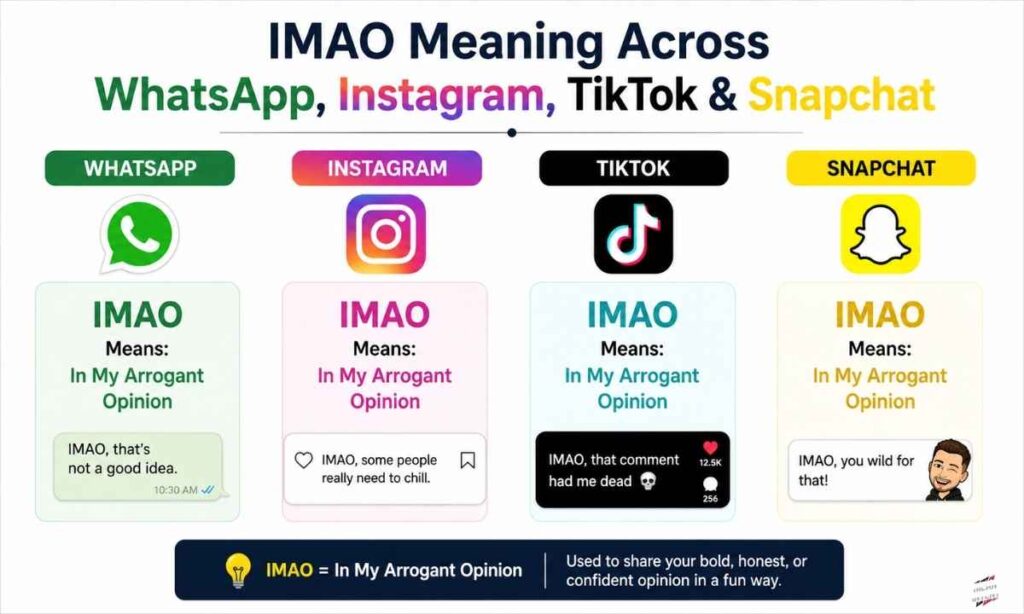
The meaning of IMAO remains mostly the same across different social media platforms, but its context may vary.
On WhatsApp, users typically use IMAO during casual conversations with friends and family.
Examples:
- “IMAO, we should order pizza.”
- “That movie ending was terrible, IMAO.”
On Instagram, IMAO appears in:
- Comments
- Story replies
- Meme captions
- Reels discussions
Examples:
- “IMAO, this outfit is iconic.”
- “Best travel reel ever, IMAO.”
TikTok
TikTok users often use IMAO to react to:
- Viral trends
- Funny videos
- Dance challenges
- Celebrity content
Examples:
- “IMAO, this trend peaked already.”
- “This creator deserves more followers.”
Snapchat
On Snapchat, IMAO is commonly used:
- In private chats
- Snap captions
- Group conversations
- Story replies
Examples:
- “IMAO, that filter looks hilarious.”
- “You definitely won today’s challenge.”
Different Meanings of IMAO in Other Fields
Although In My Arrogant Opinion is the most common meaning, some niche communities interpret IMAO differently.
| Field | Possible Meaning |
| Internet Slang | In My Arrogant Opinion |
| Humor | In My Awesome Opinion |
| Casual Chat | Sarcastic version of IMO |
| Online Forums | Exaggerated personal opinion |
However, the standard meaning remains In My Arrogant Opinion.
Common Confusions, Mistakes & Wrong Interpretations
Many people confuse IMAO with similar abbreviations.
| Acronym | Meaning |
| IMO | In My Opinion |
| IMHO | In My Humble Opinion |
| IMAO | In My Arrogant Opinion |
| LMAO | Laughing My Ass Off |
| LMFAO | Laughing My Freaking Ass Off |
Common mistakes include:
- Thinking IMAO means LMAO
- Assuming it is an insult
- Using it in formal emails
- Believing it always reflects actual arrogance
In reality, IMAO is usually playful and humorous.
Similar Terms, Alternatives & Related Slang
Several internet abbreviations serve similar purposes.
- IMO — In My Opinion
- IMHO — In My Humble Opinion
- TBH — To Be Honest
- NGL — Not Gonna Lie
- FYI — For Your Information
- IDC — I Don’t Care
- TBF — To Be Fair
- IMOF — In My Own Feeling
- ICYMI — In Case You Missed It
These expressions help users communicate opinions and emotions quickly.
Examples of IMAO in Real Chat Situations
To better understand the IMAO meaning in text, here are some real-life chat examples showing how people use this slang in everyday online conversations.
Example 1
Alex: Which streaming service is best?
Ryan: IMAO, Netflix still wins.
Example 2
Sarah: Was the concert worth it?
Emily: IMAO, absolutely yes.
Example 3
Gaming Chat:
IMAO, that strategy was genius.
Example 4
Instagram Comment:
IMAO, this photo deserves a million likes.
Example 5
TikTok Reply:
IMAO, this trend is already outdated.
How to Reply When Someone Says IMAO?
There are several ways to respond depending on the tone.
Funny replies:
- “Your arrogant opinion has been accepted.”
- “Bold statement, professor.”
- “That’s certainly one way to look at it.”
- “I’ll allow this opinion.”
Casual replies:
- “Fair enough.”
- “I can see that.”
- “Good point.”
- “Interesting take.”
Friendly disagreement:
- “I respect that, but I disagree.”
- “Maybe, but here’s my opinion.”
- “I see your point, although I think otherwise.”
Formal reply (rare use):
- “Thank you for sharing your perspective.”
- “I appreciate your viewpoint.”
What Does IMAO Mean in Gen Z?
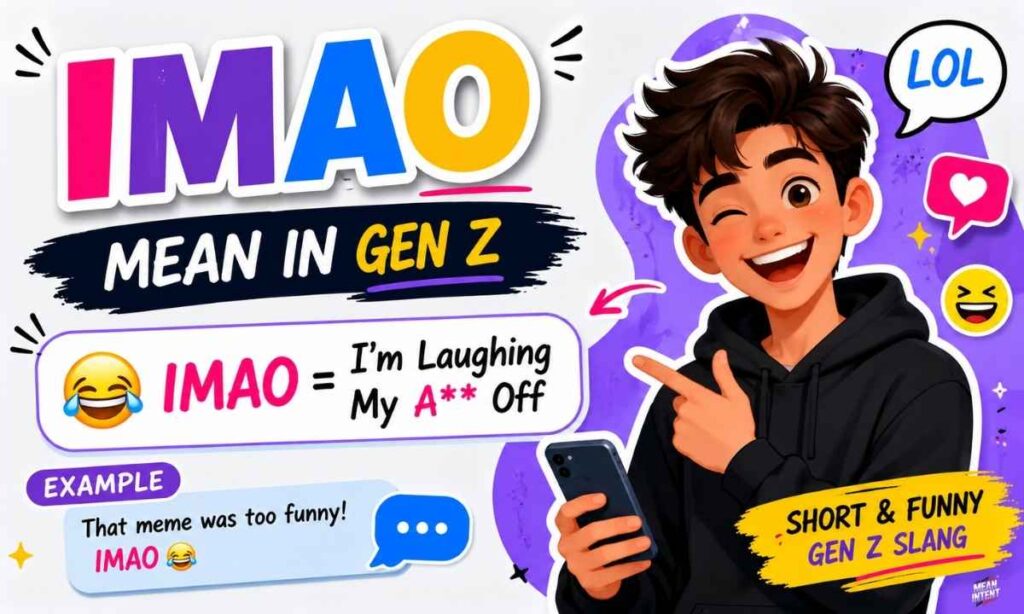
Among Gen Z, IMAO is often used as:
- A joke
- A sarcastic opinion marker
- Meme culture language
- Casual internet humor
- Exaggerated self-confidence
Gen Z users rarely use IMAO literally. Instead, they use it to make conversations more entertaining.
Example:
IMAO, pineapple belongs on pizza, and nobody can change my mind.
IMAO Meaning in Text From a Guy?
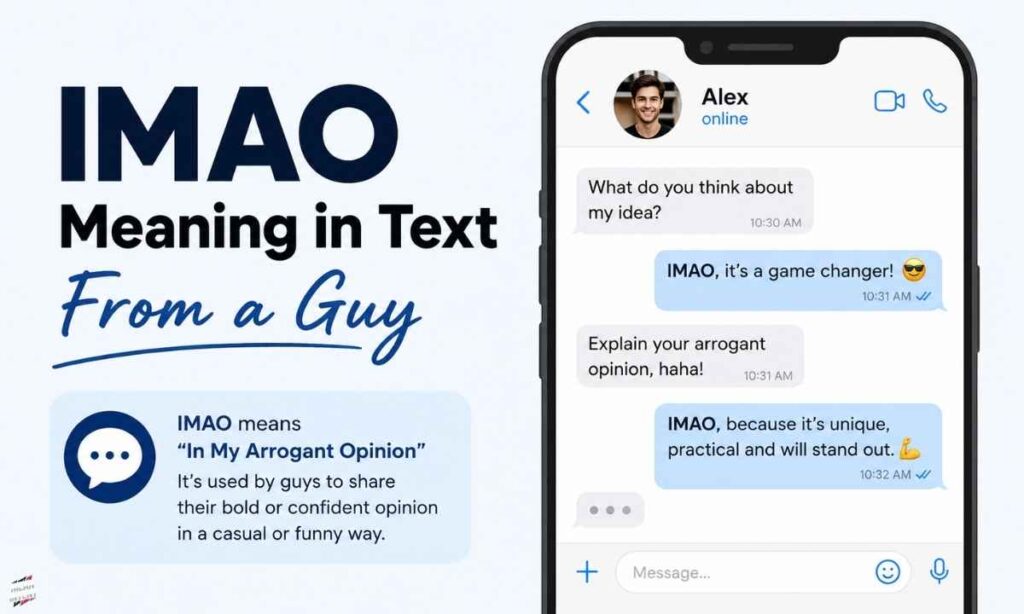
When a guy uses IMAO, it usually means:
- He’s joking
- He’s expressing a strong opinion
- He’s being sarcastic
- He’s teasing friends
- He’s participating in casual banter
Example:
IMO, football is the greatest sport ever invented.
Usually, there’s no hidden meaning behind it.
What Does IMAO Mean From a Girl?
When a girl uses IMAO, the meaning remains essentially the same.
It often indicates:
- Playfulness
- Humor
- Sarcasm
- Confidence
- Friendly teasing
Example:
IMAO, this outfit is the best one I’ve ever worn.
The interpretation depends more on context than gender.
Is IMAO a Bad Word?
No, IMAO is not a bad word.
It is considered:
- Safe
- Family-friendly
- Informal
- Humorous
- Common internet slang
However, because it contains the word “arrogant,” some people unfamiliar with internet slang may misunderstand its tone.
IMAO Meaning in Tagalog
In Tagalog-speaking online communities, IMAO generally keeps its English meaning:
“In My Arrogant Opinion”
A rough Tagalog interpretation could be:
“Sa aking medyo mayabang na opinyon.”
Filipino internet users often use the English acronym directly rather than translating it.
Is IMAO Still Popular? Trends & Online Usage
Although not as common as LOL, LMAO, or IMO, IMAO continues to appear regularly in internet culture.
Who uses it most?
- Gen Z users
- Gamers
- Meme creators
- TikTok users
- Reddit communities
- Discord users
- Social media commenters
Trend status:
| Platform | Popularity |
| TikTok | Moderate |
| Moderate | |
| Snapchat | Common |
| Common | |
| High | |
| Discord | High |
IMAO remains a niche but recognizable internet slang term.
Quick Facts Section
| Question | Answer |
| Full Form | In My Arrogant Opinion |
| Meaning | Humorous personal opinion |
| Tone | Sarcastic and playful |
| Formal? | No |
| Offensive? | No |
| Popular With | Gen Z and internet users |
| Used On | WhatsApp, TikTok, Instagram, Snapchat |
| Similar Terms | IMO, IMHO, TBH |
Frequently Asked Questions
What does IMAO stand for?
IMAO stands for “In My Arrogant Opinion.”
Is IMAO the same as IMO?
No. IMO means “In My Opinion,” while IMAO adds humor and sarcasm.
Is IMAO rude?
Usually no. It is typically used jokingly.
Do people still use IMAO?
Yes, especially on social media, Reddit, Discord, and gaming platforms.
Can I use IMAO in professional emails?
No. IMAO is considered informal internet slang.
Is IMAO popular among Gen Z?
Yes. Gen Z users frequently use it in memes and casual conversations.
Conclusion
Understanding the IMAO meaning in text helps you navigate modern online communication more confidently. While it literally stands for “In My Arrogant Opinion,” the phrase is rarely meant to be genuinely arrogant. Instead, it adds humor, sarcasm, and personality to digital conversations.
Whether you’re chatting on WhatsApp, commenting on Instagram, posting on TikTok, or messaging on Snapchat, knowing how and when to use IMAO can make your online interactions sound more natural and engaging. Although internet slang constantly evolves, IMAO remains a recognizable and entertaining expression that continues to thrive in modern digital culture.

John Marvel is a passionate writer with 4 years of experience exploring words and ideas. He runs an engaging blog focused on the meaning niche, where he dives deep into the origins, interpretations, and insights behind everyday terms. John loves making complex concepts simple and interesting for his readers. His curiosity drives him to uncover hidden stories and meanings that spark thought and conversation.