If you have ever scrolled through social media and seen someone mention their significant other, you might wonder about the s/o meaning slang in a modern context. Essentially, it is a shorthand way to refer to a partner or spouse without using gender-specific labels. This digital acronym has become a staple in online communication, allowing people to express affection and commitment while keeping their status clear yet concise for their audience.
Ever felt out of the loop when a viral post mentions a long-term “S.O.”? You are not alone in navigating this internet lingo. Understanding these common terms is the ultimate key to mastering social media trends and casual texting. Let’s dive into why this abbreviation is so popular among Gen Z and Millennials today.
This trendy expression serves as a gender-neutral way to describe a serious relationship. By using this popular phrase, users maintain privacy while still sharing their romantic life. It is a versatile part of our modern vocabulary that defines intimacy in the digital age quite perfectly.
What Does S/O Mean in Slang?
At its core, “S/O” is a versatile abbreviation that dominates the digital landscape. Depending on where you see it, the term carries two distinct weights: it either identifies a deeply valued romantic partner or acts as a public acknowledgement of someone’s contribution. In the context of 2026’s social norms, this slang is a byproduct of the “efficiency first” mindset that governs our apps and messaging platforms.
Understanding the s/o meaning slang requires looking at the intent behind the message. It is a linguistic bridge that connects our private lives with our public personas. Whether you are tagging a friend on a story or filling out an emergency contact form that asks for your “S.O.,” the term is designed to save time without sacrificing the importance of the individual being mentioned. It is a prime example of how modern English adapts to the constraints of the screens we use every day.
S/O as “Shoutout” – Full Explanation
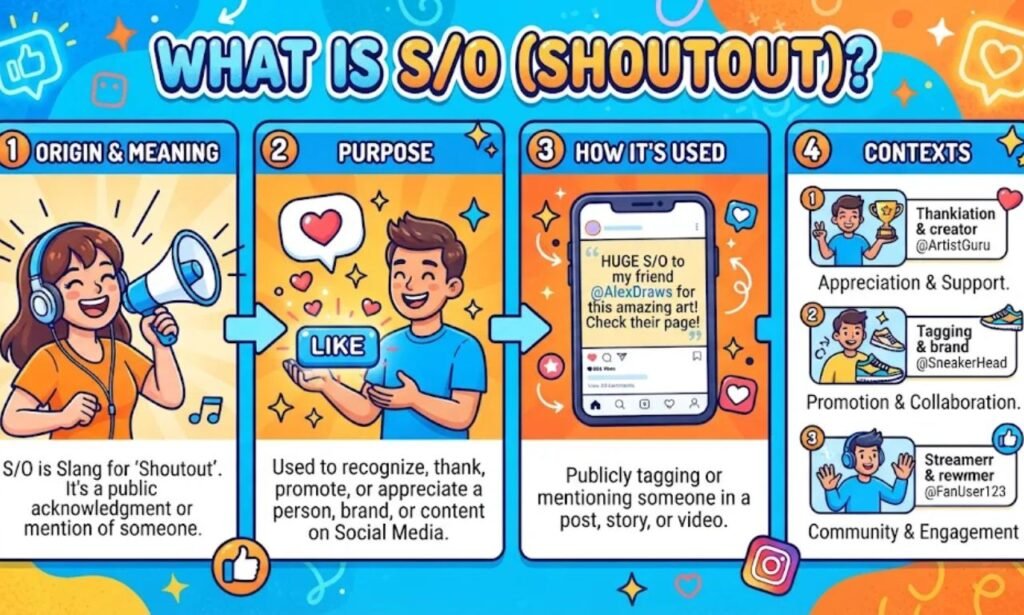
When used as an action or a public gesture, “S/O” stands for Shoutout. This version of the slang is used to give credit, express gratitude, or draw attention to another person, brand, or group. It is the digital equivalent of a “hat tip.” For example, a creator might say, “Big S/O to the team for helping with this video,” which effectively highlights the hard work of others.
The “shoutout” is a cornerstone of community building. By using this abbreviation, users can publicly validate others, which fosters a sense of belonging and mutual support. In the economy of social attention, an S/O is a form of social currency. It is often used to boost smaller accounts or to thank a mentor for their guidance. Because it is short and punchy, it fits perfectly into captions, live streams, and rapid-fire comment sections.
S/O as “Significant Other” – What It Means
The second, and perhaps more intimate, definition of “S/O” is Significant Other. In this context, it refers to a spouse, domestic partner, or long-term romantic interest. This usage is favored for its gender-neutrality and its ability to bypass the specific legal or social baggage that terms like “fiancé” or “husband” might carry.
In 2026, referring to a partner as an “S/O” is seen as both modern and respectful. It allows for a level of privacy—you can discuss your life and your partner without immediately disclosing their gender or the exact legal status of your union. This makes it a popular choice for people in the LGBTQ+ community or those who prefer to keep their personal details offline while still acknowledging that they are in a committed relationship.
How to Tell Which Meaning of S/O Is Being Used
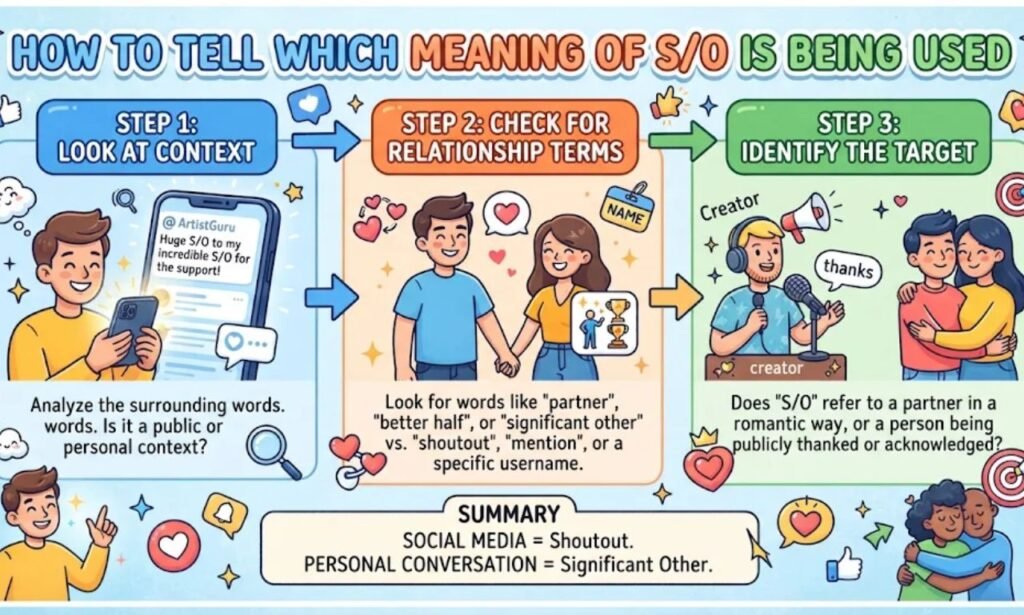
Distinguishing between a “shoutout” and a “significant other” usually comes down to the sentence structure and the platform being used. It can be confusing for newcomers, but a few simple cues can help you decipher the message instantly.
Consider the following contextual indicators:
- Presence of a Verb: If the sentence starts with “Give a…” or “Big…”, it almost always means “shoutout.”
- Possessive Pronouns: If the term is preceded by “my,” “their,” or “your” (e.g., “my S/O”), it refers to a romantic partner.
- Placement: At the end of a post as a hashtag (#SO), it is typically a shoutout. In the middle of a story about a dinner date, it is a significant other.
S/O Meaning in Text Messages
In the private sphere of text messaging, “S/O” is almost exclusively used to refer to a partner. When texting friends about weekend plans, using “S/O” is a quick way to indicate that your partner will be joining without typing out a long title. It signals a level of comfort and informality between the people in the chat.
However, in group chats, the meaning can occasionally flip. If a friend does you a favor and you reply, “S/O to [Name] for the help,” you are using the shoutout definition. Because text messages lack the visual cues of social media, the surrounding conversation provides the necessary clues. If the topic is relationships, think “partner.” If the topic is tasks or favors, think “thanks.”
S/O Meaning on Social Media (Instagram, Snapchat, Twitter)
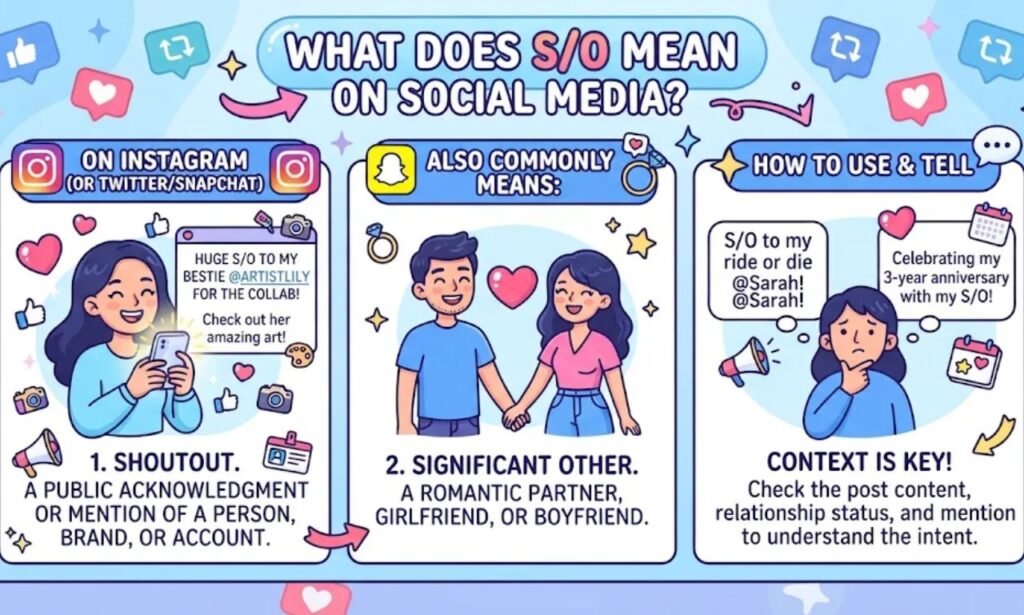
Social media is where the “shoutout” definition truly shines. On platforms like Instagram and Snapchat, an S/O is a visual gesture. Users often post a “S/O Sunday” or use their stories to tag friends.
- Instagram: Often seen in “Stories” where one user shares another’s post to their own followers.
- Snapchat: Used in captions of photos to thank the person who took the picture.
- Twitter (X): Frequently used in “threads” to credit sources or acknowledge influential thinkers.
On these platforms, the term acts as a link. It physically and figuratively connects two accounts, driving traffic and engagement from one profile to another. It is the primary way people network in a decentralized digital environment.
Real-Life Examples of S/O in Sentences
To see how these meanings function in the real world, let’s look at some common phrases used in 2026.
| Sentence | Meaning | Context |
| “I need to check with my S/O before I book the flights.” | Significant Other | Planning/Logistics |
| “A huge S/O to everyone who donated to the charity today!” | Shoutout | Gratitude/Publicity |
| “Is your S/O coming to the party on Friday?” | Significant Other | Social Invitation |
| “I’d like to give an S/O to my editor for the quick turnaround.” | Shoutout | Professional Credit |
As demonstrated, the word “my” or “your” is the biggest giveaway for the romantic definition. Without those pronouns, the word usually functions as a noun representing a public thank-you.
When Should You Use S/O?
You should use “S/O” when you want to be brief, inclusive, or casual. It is perfect for social media captions where space is limited and for casual emails where you want to sound approachable but professional. It is also the best choice when you are unsure of someone’s preferred relationship terminology; using “S/O” is a safe, respectful default that avoids making assumptions.
When You Should Avoid Using S/O
Avoid using this slang in highly formal or legal environments. For example, in a court of law, a formal wedding invitation, or a high-stakes corporate contract, “Significant Other” should be written out in full, or the specific legal term (like “spouse”) should be used. Additionally, if you are speaking to an older generation that may not be familiar with internet shorthand, using the acronym might lead to a breakdown in communication.
Common Mistakes People Make with S/O
The most common mistake is failing to provide enough context, leading to “ambiguous shorthand.” If you say, “I have an S/O today,” people might be confused—do you have a date, or did you get a shoutout?
Another mistake is overusing the term. In 2026, “semantic fatigue” is real. If every post is a “shoutout,” the value of the gesture decreases. Similarly, referring to a brand-new date as your “S/O” might signal a level of commitment that isn’t quite there yet, as the term usually implies a “significant” or serious bond.
S/O vs Other Popular Slang Terms
“S/O” often competes with other terms like “Bae,” “Partner,” or “Mentions.”
- Vs. Partner: “Partner” is slightly more formal and often used in workplace benefits or cohabitation discussions.
- Vs. Bae: “Bae” is more affectionate and often used in a playful or “cutesy” way, whereas “S/O” feels more grounded.
- Vs. Mention: A “mention” is a technical term for tagging someone, while an “S/O” is the emotional or social intent behind that tag.
The Origin of S/O in Internet Slang
The roots of “S/O” go back to early 2000s forum culture. “Significant Other” was a popular way to discuss partners on parenting and relationship forums (like Reddit’s early days) to maintain a degree of anonymity. The “Shoutout” version evolved from hip-hop culture, where artists would “shout out” their hometowns or friends during tracks. As these two worlds collided on social media, the acronym became the dominant way to express both ideas.
Why S/O Is So Popular Online
Its popularity stems from its multimodal utility. It works as a noun, a verb, and an adjective. In the 2026 digital economy, where influencers and everyday users alike are constantly collaborating, having a three-character way to give credit or mention a loved one is incredibly valuable. It fits the “scan-ability” of modern content, allowing readers to understand the relationship dynamic of a post in a fraction of a second.
Alternative Meanings of S/O (Non-Slang)
While we focus on slang, it is important to remember that “S/O” can stand for other things in specific fields:
- Shipping Order: In logistics and e-commerce, an S/O is a document issued by a carrier.
- Strikeout: In baseball statistics, “SO” is the abbreviation for when a batter is called out on three strikes.
- Shutout: In sports like hockey or soccer, it refers to a game where one team prevents the other from scoring.
Quick Recap of S/O Meaning
- Meaning 1: Significant Other (Partner/Spouse).
- Meaning 2: Shoutout (Credit/Gratitude).
- Usage: High in social media, moderate in professional casual settings.
- Key Indicator: Look for possessive pronouns (my/your) to identify the partner meaning.
Final Thoughts
Language is a living entity, and the s/o meaning slang is a perfect example of how we compress complex human emotions into simple digital icons. Whether you are honoring your partner or boosting a colleague, “S/O” provides the flexibility and speed required for 2026’s communication standards. By mastering these small but mighty terms, you ensure your voice remains relevant and clear in an increasingly crowded digital world.
Frequently Asked Questions
What is the primary definition of s/o meaning slang?
It most commonly refers to a significant other, such as a romantic partner, spouse, or committed long-term companion.
How do people use s/o as a shoutout?
Users give an S/O to publicly acknowledge, thank, or credit someone for their contribution or support online.
Is s/o considered gender-neutral?
Yes, it is a versatile, inclusive term that describes a partnership without specifying gender or legal marital status.
When should I use this slang?
Use it in digital chats or social media captions for efficiency, privacy, and to keep your communication modern.
Can s/o mean something in sports?
In a technical or athletic context, it often stands for a strikeout or a shutout during competitive games.

Abu Bakar is a passionate writer with 4 years of experience exploring words and ideas. He runs an engaging blog focused on the meaning niche, where he dives deep into the origins, interpretations, and insights behind everyday terms. He loves making complex concepts simple and interesting for his readers. His curiosity drives him to uncover hidden stories and meanings that spark thought and conversation.