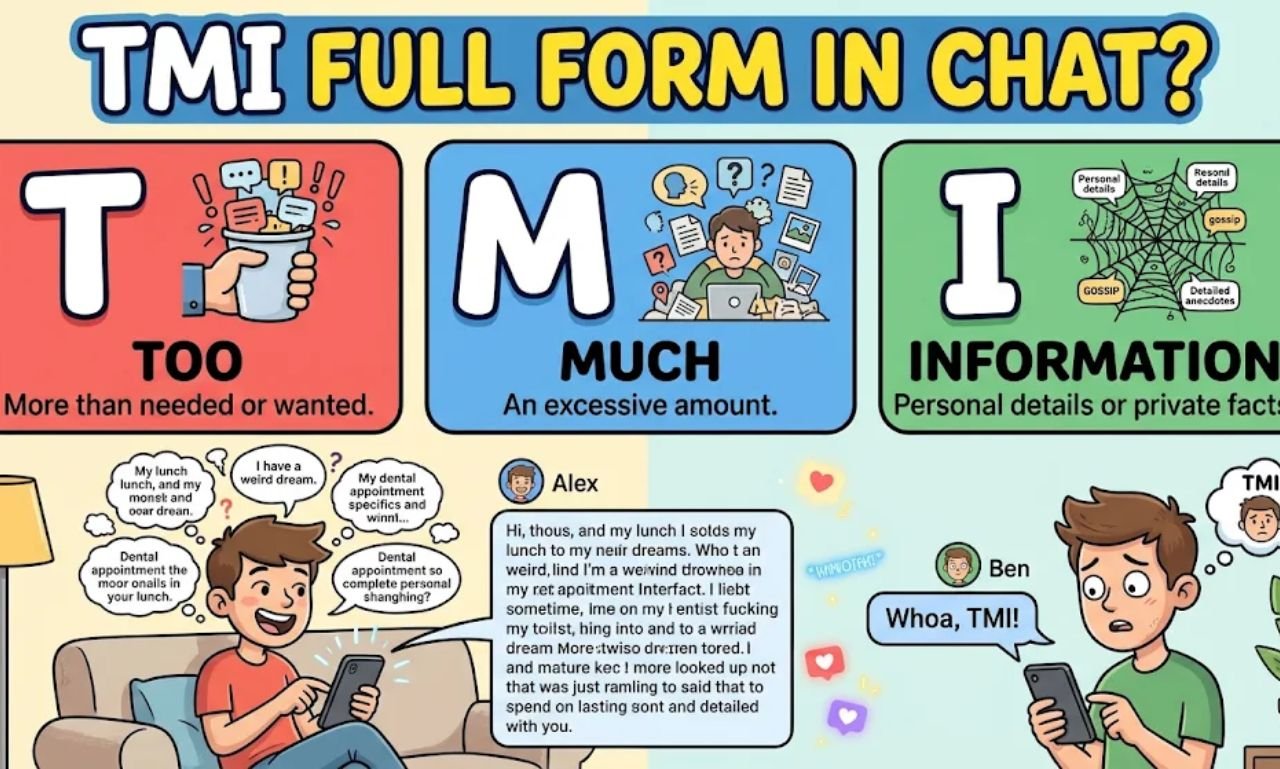
Ever wondered what someone means when they drop those three letters in a text? Knowing the tmi full form in chat is essential for navigating modern digital communication without any awkward pauses. It basically tells the other person they are sharing personal details that are way too graphic or private for the current social context of your online conversation.
Ever felt like you just heard way too much about a friend’s medical issues or messy breakup over instant messaging? That cringey feeling is exactly why this slang term exists in our social media world. It acts as a social cue to stop the oversharing before things get even more uncomfortable for everyone reading the thread.
Using this acronym helps maintain healthy boundaries during real-time messaging. It is a shorthand way to keep informal chats light and respectful. Whether you are on WhatsApp or Discord, understanding these linguistic shortcuts ensures your virtual interactions remain smooth and socially appropriate for all active participants.
The Digital Etiquette Guide: Understanding the TMI Full Form in Chat
In the fast-paced world of online communication, mastering the shorthand that defines our social interactions is crucial for maintaining healthy boundaries. This comprehensive guide explores the cultural and linguistic impact of oversharing in the modern age. We dive deep into the tmi full form in chat, its historical origins, and how it serves as a vital social regulator across platforms like WhatsApp, Slack, and Discord. You will learn about the psychological drivers behind providing too much detail, how to identify social cues in text-based environments, and the best practices for professional messaging. This guide provides a definitive look at maintaining conversational balance in 2026.
What Does TMI Mean in Chat?
At its core, the term is used to signal that a conversation has veered into territory that is uncomfortably personal or unnecessarily detailed. When someone sends these three letters, they are essentially hitting a “pause button” on the information flow. In the digital landscape of 2026, where we often communicate with people across different time zones and cultural backgrounds, having a universal shorthand to establish comfort levels is indispensable.
The term functions as a pragmatic marker. It doesn’t just convey a definition; it conveys a feeling of social awkwardness. Whether it’s a graphic description of a medical procedure or an intimate detail about a romantic relationship, the label suggests that the recipient has reached their bandwidth limit for that specific topic.
Full Form of TMI in Text Messaging
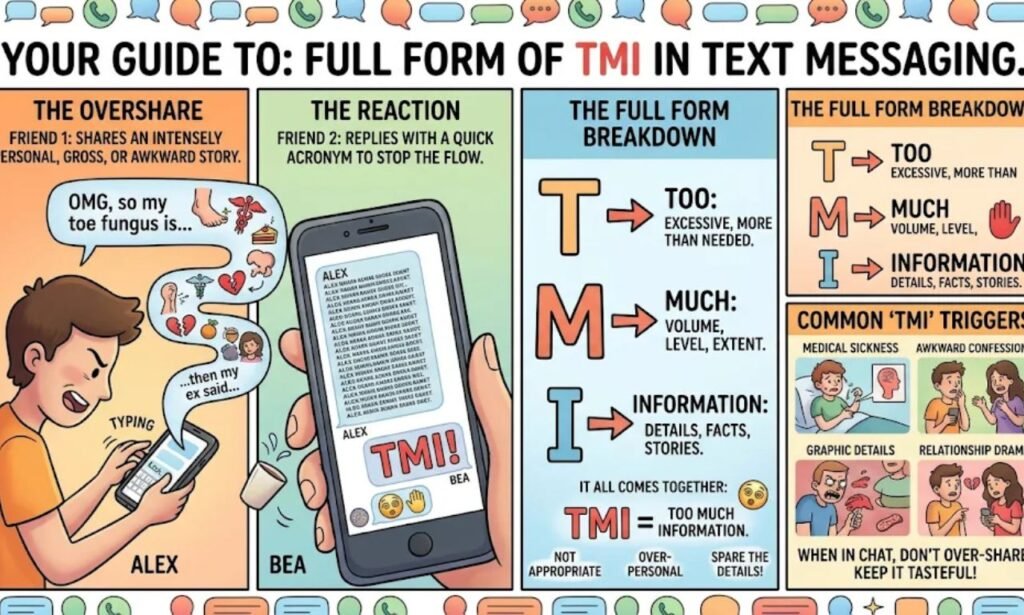
The full form in chat stands for “Too Much Information.” While it sounds simple, the application of this acronym in instant messaging is nuanced. It is rarely used to describe a high volume of helpful facts; instead, it almost exclusively refers to personal data that violates social norms.
In modern texting, the full form is understood globally. It has moved beyond English-speaking circles to become a staple of global digital slang. Because mobile keyboards and touchscreens favor linguistic shortcuts, using the initialism is much more common than typing out the full three words. It allows the user to shut down an uncomfortable topic quickly without escalating a confrontational tone.
Origin of the Term TMI
While many believe this is a product of the smartphone era, the roots of the phrase go back to the late 20th century. It gained significant traction in the 1990s as internet culture began to flourish in chat rooms and bulletin board systems (BBS). Linguists suggest it was a natural evolution of the need to police online behavior in spaces where people felt a sense of anonymity.
By the early 2000s, the term was officially recognized in mainstream dictionaries, solidifying its place in modern English. In 2026, it remains just as relevant because the online disinhibition effect—the tendency to say things online that one would never say in person—is still a major factor in how we use social media and private messaging apps.
When Do People Use TMI in Conversations?
People typically deploy this slang term when they feel their privacy or mental space is being invaded by someone else’s unsolicited details. It is a defensive tool used to maintain a respectful distance.
Usage usually spikes in the following scenarios:
- Medical Over-sharing: When someone describes a physical ailment in visceral detail.
- Relationship Venting: Sharing intimate secrets about a partner that the listener didn’t ask to hear.
- Bodily Functions: Explicitly discussing bathroom habits or other private physical acts.
- Financial Stress: Detailing specific debt numbers or bank balances in a casual setting.
Real-Life Examples of TMI in Chat
To understand the social context, it helps to see how these virtual interactions play out in real-time.
Example A (Casual Friendships):
- Person 1: “I have the worst rash on my lower back, it’s all scaly and oozing this green—”
- Person 2: “Whoa, TMI! Hope you feel better, but I didn’t need the visual.”
Example B (Professional Setting):
- Colleague 1: “Sorry I’m late to the Zoom, my cat had explosive diarrhea all over my rug and I had to scrub it with—”
- Colleague 2: “TMI, let’s just get started with the project update.”
In both cases, the acronym acts as a social cue to pivot back to a more appropriate topic.
How to Use TMI Correctly in Texting
Using the term requires a balance of assertiveness and empathy. If you use it too harshly, you might offend a friend who is genuinely reaching out for support. If you use it too lightly, the oversharing might continue.
To use it effectively:
- Pair it with an Emoji: Adding a 😅 (sweat smile) or 🛑 (stop sign) can soften the blow.
- Redirect the Conversation: After saying it, immediately ask a question about something else.
- Be Honest but Kind: In direct messages, you can say, “That’s a bit TMI for me right now, can we talk about the movie instead?”
Tone and Context of Using TMI
The tonality of the phrase changes based on the platform. On Discord, within a gaming community, it might be used jokingly among “internet friends.” However, on LinkedIn or Slack, it carries a much more serious professional weight.
| Context | Tone | Acceptability |
| Best Friends | Joking / Blunt | Very High |
| Work Colleagues | Professional / Firm | Moderate |
| First Dates | Awkward / Defensive | Low (High risk of ghosting) |
| Family Groups | Protective / Direct | High |
The data above shows that as the relationship hierarchy becomes more formal, the use of the term becomes more of a boundary-setting necessity rather than a joke.
Common Situations Where TMI Appears Online
In 2026, certain digital environments are breeding grounds for oversharing. Social media platforms that encourage “storytelling” often see users post long threads about their personal lives. While some find this “authentic,” others view it as a massive TMI violation of the public feed.
Group chats are another common area. When one person shares something graphic, it affects every active participant in the thread. This often leads to multiple people responding with the initialism to collectively reset the group dynamic.
Similar Internet Slang to TMI
The linguistic landscape of 2026 includes several other shorthand terms that deal with information control and social boundaries.
- Oversharing: The literal verb for giving too much info.
- NSFW (Not Safe For Work): Used for content that is graphic or explicit.
- Cringe: A reaction to someone doing something socially uncomfortable.
- TL;DR (Too Long; Didn’t Read): Used when the volume of text is too high, regardless of the content.
- Vent: When someone intentionally shares a lot of emotional data, usually with a warning first.
Why Learning Chat Acronyms Like TMI Is Important
In a world dominated by virtual interactions, understanding digital linguistics is a form of emotional intelligence. If you don’t know the full form in chat, you might miss a clear sign that you are making your friends or colleagues uncomfortable.
Learning these shorthand terms helps you:
- Maintain Professionalism: Avoid “cringe” moments in the workplace.
- Build Better Relationships: Understand and respect the privacy limits of others.
- Communicate Efficiently: Save time by using recognized acronyms for common social cues.
Conclusion
Navigating the nuances of modern digital etiquette is an ongoing process. The tmi full form in chat—Too Much Information—is a vital tool in our communication toolkit. It allows us to protect our mental space and maintain respectful boundaries in an era where everyone is “always on.” By being mindful of the social context and recognizing the signs of oversharing, we can ensure our online conversations remain productive, comfortable, and meaningful for everyone involved. Keep your chats engaging, but remember that sometimes, less is definitely more.

Abu Bakar is a passionate writer with 4 years of experience exploring words and ideas. He runs an engaging blog focused on the meaning niche, where he dives deep into the origins, interpretations, and insights behind everyday terms. He loves making complex concepts simple and interesting for his readers. His curiosity drives him to uncover hidden stories and meanings that spark thought and conversation.