If you’ve been scrolling through Snapchat, Discord, or a group chat and someone fired back with “STFU,” you’re not alone in wondering exactly what they meant. Is it a joke? An insult? Something in between?
STFU is one of the most widely used acronyms in modern texting, and its meaning shifts dramatically depending on who sends it, the platform it’s sent on, and whether an emoji softens the blow. This guide breaks down everything you need to know — from its literal definition to its tone, origin, and real-world usage across every major app.
What Does STFU Mean in Text?
At its core, STFU is a fast, punchy way to tell someone to stop talking — but in modern texting, it rarely means that literally. It’s turned into an all-purpose reaction word that can express shock, laughter, annoyance, or genuine anger depending on how it’s used.
Acronym Breakdown
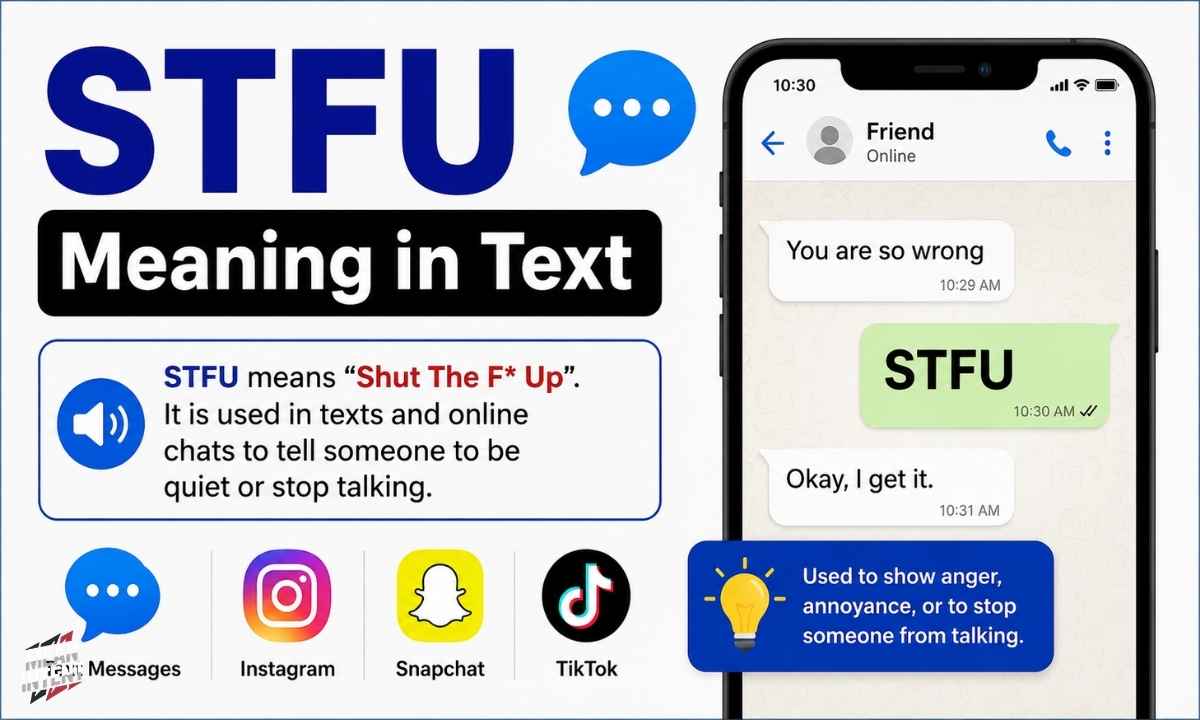
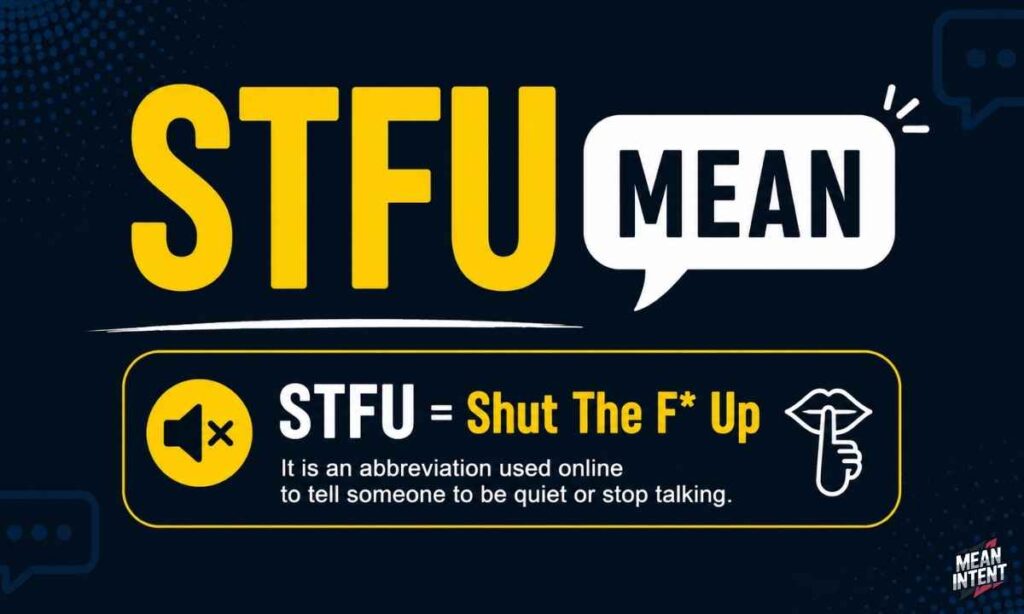
STFU stands for “Shut The F* Up.”** It’s a blunt, no-filter way of telling someone to stop talking immediately.
Each letter breaks down like this:
| Letter | Stands For |
| S | Shut |
| T | The |
| F | F*** |
| U | Up |
Simple Definition
In plain terms, STFU is an aggressive or playful command to be quiet. It can express genuine anger, mock outrage, disbelief, or excitement — the meaning depends entirely on context.
Origin and History of STFU
STFU emerged from early internet forums and chat rooms in the late 1990s and early 2000s, alongside other now-classic acronyms like LOL, BRB, and OMG. As texting and instant messaging exploded in popularity, abbreviations like STFU became a fast way to express strong reactions without typing full sentences.
Gaming communities and early messaging platforms like AIM and MSN Messenger helped popularize the term, and it later found a permanent home in texting culture, social media comments, and meme captions. Today, it’s a staple of internet slang recognized across generations, though it’s most heavily used by Gen Z and younger millennials.
Is STFU Always Rude?
Not necessarily. While STFU literally translates to a harsh command, its real-world tone is far more flexible.
- Rude context: Used during an argument, sent with no emoji, in all caps — this reads as genuinely hostile.
- Friendly context: Used between close friends reacting to surprising or funny news — this reads as playful disbelief, similar to saying “no way!”
The relationship between the sender and receiver matters just as much as the words themselves.
STFU Tone Guide: What It Really Means
The Golden Rule: Emojis = Friendlier, No Emojis = Colder
This is the single most important rule for decoding STFU in any conversation.
| Format | Likely Tone | Meaning |
| STFU | Playful | “No way, that’s hilarious!” |
| STFU | Shocked/amused | “I can’t believe this happened” |
| STFU. | Serious | Genuine frustration or anger |
| STFU!! | Heated | Strong annoyance, possibly hostile |
| stfu (lowercase, no punctuation) | Casual | Mild, joking reaction |
If in doubt, look at the punctuation and any emojis attached. A period at the end almost always signals seriousness.
STFU Meaning From a Girl
When girls use STFU in texting, it’s frequently tied to excitement, disbelief, or reacting to gossip or unexpected news. Common examples include:
- Reacting to a friend’s surprising relationship update
- Responding to shocking celebrity or influencer news
- Expressing exaggerated excitement over good news
When It Can Feel Rude
STFU from a girl can carry real irritation when:
- It’s sent during a disagreement or argument
- It follows a serious or sensitive topic
- There’s no emoji, exclamation, or softening language
STFU Meaning From a Guy
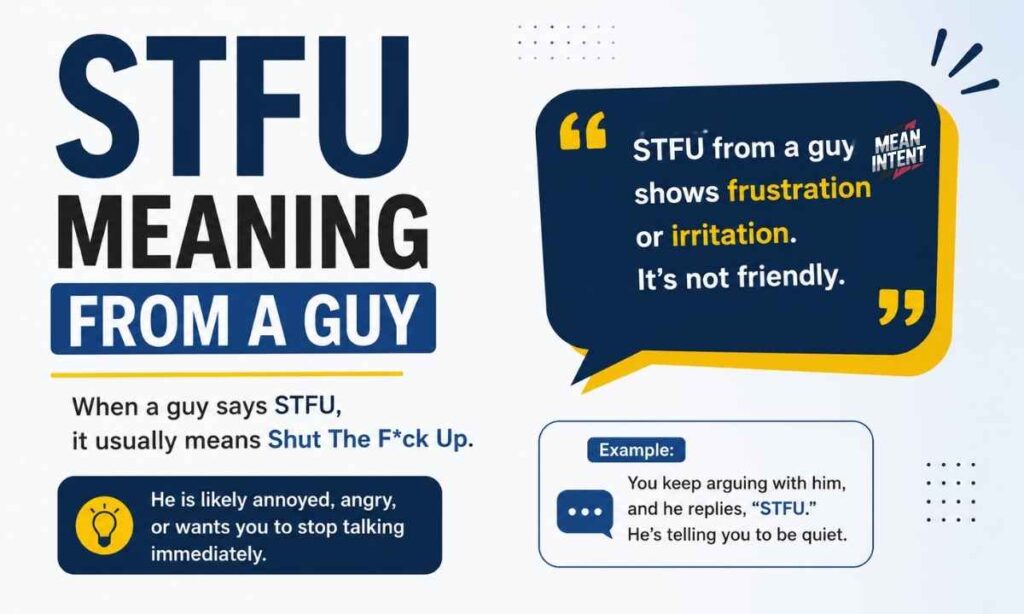
Among guys, especially in gaming chats or sports conversations, STFU often functions as banter. It’s commonly used:
- During competitive gaming as trash talk
- When reacting to a friend’s joke or roast
- To express disbelief over a sports result or prank
In male friend groups, STFU is frequently a badge of camaraderie rather than an insult — though tone and history between friends still matter.
What Does STFU Mean in Text Messages?
In one-on-one text messages, STFU usually appears as a reaction rather than an instruction. It’s less about literally silencing someone and more about signaling strong emotion — shock, amusement, annoyance, or disbelief — in response to something just said.
What Does STFU Mean in Texting?
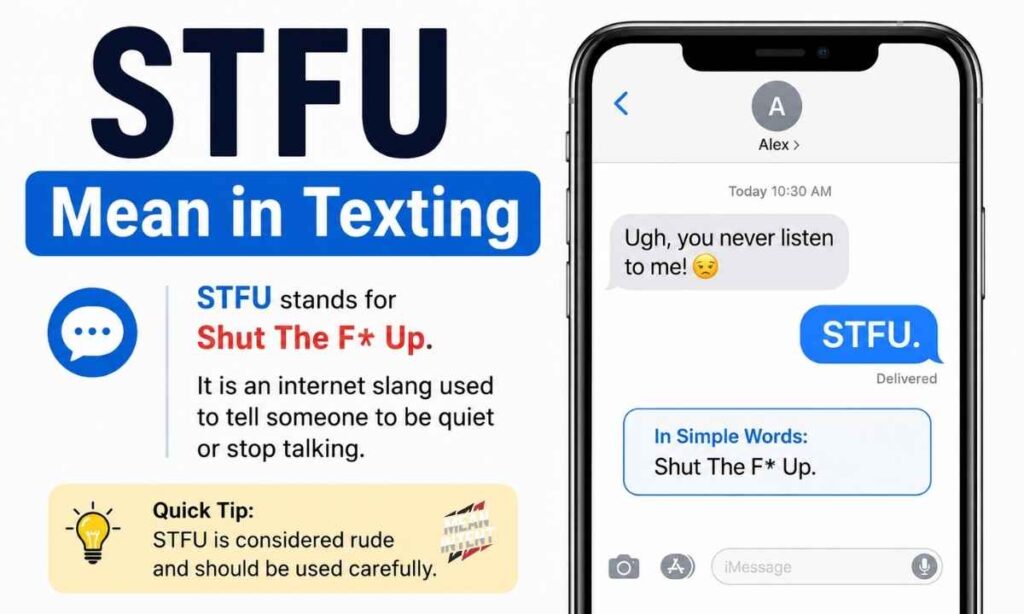
Functionally, STFU in texting acts as a filler expression much like “no way” or “shut up” in spoken English. English speakers have long used “shut up” as an exclamation of surprise, and STFU is simply the more intense, internet-native version of that same instinct.
STFU Grammar and Language Role
Grammatically, STFU behaves as an interjection — a standalone expression of emotion rather than a formal sentence. It doesn’t require conjugation, subjects, or objects, and it can stand entirely on its own in a text bubble.
It can also function as:
- An imperative command (“STFU right now”)
- An exclamation of disbelief (“STFU, really?!”)
- A one-word reaction to shocking content
Real Conversation Examples of STFU
- Friend A: “I got the internship!” Friend B: “STFU!! Congrats!!”
- Gaming chat: “You just got outplayed lol” Reply: “stfu 😭”
- Argument context: “Just stop talking. STFU.”
- Group chat: “She actually said that to his face?” Reply: “STFU no she didn’t”
When Do People Use STFU?
STFU tends to appear in these situations:
- Reacting to surprising or unbelievable news
- Playful roasting between friends
- Genuine frustration during disagreements
- Gaming and competitive banter
- Commenting on memes or viral content
STFU on Every Platform
The way STFU lands can shift quite a bit depending on where it’s sent, since each app has its own texting culture, tone, and typical audience.
Snapchat
On Snapchat, STFU is often used casually in response to a snap or story, typically paired with laughing or shocked emojis.
In Instagram comments and DMs, STFU frequently reacts to surprising posts, often written in lowercase for a casual tone.
TikTok
TikTok comment sections use STFU heavily as a reaction to unexpected video content, usually meant humorously rather than aggressively.
WhatsApp & iMessage
In private messaging apps, STFU appears more personally and can carry either playful or serious tones depending on the closeness of the relationship.
Discord & Gaming Chats
Discord and gaming communities use STFU as competitive banter, often stripped of any real hostility and treated as part of normal trash talk.
Twitter/X
On Twitter/X, STFU is common in reply threads, often used to dismiss an opinion sarcastically or express public disagreement.
STFU vs Similar Slang: Full Comparison
| Slang | Meaning | Typical Tone |
| STFU | Shut the f*** up | Ranges from playful to hostile |
| GTFO | Get the f*** out | Usually more aggressive |
| SMH | Shaking my head | Disapproval, no anger |
| IDC | I don’t care | Dismissive |
| STFU UP | Emphasized STFU | Rare, intensified |
| Shut up | Softer, no acronym | Mild surprise or annoyance |
STFU in Gen Z Culture
Among Gen Z, STFU has largely lost its shock value and become a normalized reaction word, much like “no cap” or “fr fr.” It’s frequently used in a lighthearted way to express disbelief rather than genuine hostility, especially when paired with laughing emojis or all lowercase text.
| Gen Z Usage Style | Typical Meaning | Example |
| Lowercase, no punctuation | Casual, low-key reaction | “stfu that’s crazy” |
| Paired with or | Amused disbelief | “STFU no way” |
| All caps with exclamation | Excited shock | “STFU!! FOR REAL?!” |
| Used in comments/replies | Public reaction to content | “stfu this is so real” |
STFU in Meme Culture
STFU regularly appears in reaction memes, screenshots of dramatic text exchanges, and caption-based humor. It’s often used ironically, mimicking overblown reactions to mundane situations for comedic effect.
Do’s and Don’ts of Using STFU
Knowing when STFU works in your favor and when it can backfire comes down to reading the room before you hit send.
Do’s
| Do | Why It Works |
| Use it with close friends who understand your tone | Reduces risk of misinterpretation |
| Pair it with emojis to signal playfulness | Makes intent clearly lighthearted |
| Save it for casual, low-stakes conversations | Keeps the reaction fun, not confrontational |
Don’ts
| Don’t | Why It’s Risky |
| Send it to someone you don’t know well | Comes across as disrespectful or aggressive |
| Use it during serious or emotional conversations | Can feel dismissive of real feelings |
| Send it in professional or formal settings | Seen as unprofessional and inappropriate |
Safer Alternatives to STFU
If you want to express the same reaction with less intensity, try:
- “No way!”
- “Shut up (no way).”
- “Wait what?!”
- “I can’t even”
- “You’re kidding”
Emotional and Psychological Impact of STFU
Like most slang, STFU’s effect on the reader depends less on the word itself and more on the context surrounding it; the same two letters can land as a joke or as a genuine put-down.
When STFU Can Hurt
Used in anger, STFU can feel dismissive or disrespectful, especially in serious conversations or when there’s a power imbalance between the sender and receiver.
When STFU Is Totally Harmless
Among close friends reacting to exciting or funny news, STFU is almost always harmless and simply mirrors excitement or disbelief.
Quick Reference Summary
| Aspect | Detail |
| Full form | Shut The F*** Up |
| Origin | Late 1990s/early 2000s internet slang |
| Tone with emoji | Playful, friendly |
| Tone without emoji | Serious, potentially rude |
| Common platforms | Snapchat, Discord, Instagram, TikTok |
| Grammar role | Interjection |
Frequently Asked Questions
Is STFU offensive?
It can be, depending on context — but among friends it’s often used playfully.
What does STFU mean from a girl?
Usually excitement or disbelief, unless sent during an argument.
What does STFU mean from a guy?
Often banter or a joking reaction, especially in gaming or sports chats.
Is STFU appropriate for professional messages?
No, it should be avoided in formal or workplace communication.
Does STFU always mean anger?
No, tone depends heavily on emojis, punctuation, and relationship context.
What’s a nicer way to say STFU?
Try “no way” or “shut up” without the acronym for a softer tone.
Conclusion
STFU is far more nuanced than its literal definition suggests. While it technically means “Shut The F*** Up,” its real-world meaning shifts based on emojis, punctuation, platform, and the relationship between sender and receiver. In many cases, it’s simply a fast, expressive way to react to shocking or funny news among friends. Understanding the context clues — tone, emojis, and conversation history — will help you correctly read STFU any time it lands in your inbox.

John Marvel is a passionate writer with 4 years of experience exploring words and ideas. He runs an engaging blog focused on the meaning niche, where he dives deep into the origins, interpretations, and insights behind everyday terms. John loves making complex concepts simple and interesting for his readers. His curiosity drives him to uncover hidden stories and meanings that spark thought and conversation.