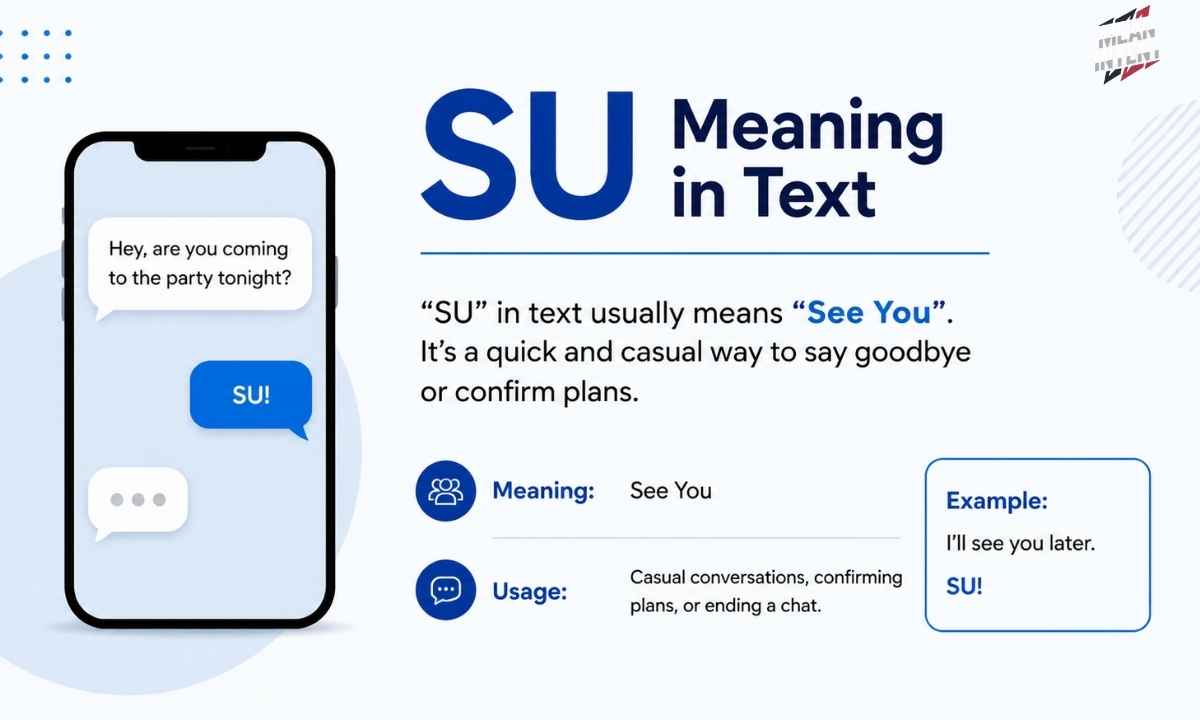
If you’ve ever gotten a text that just says “su” and wondered whether your friend is greeting you or telling you to be quiet, you’re not alone. SU is one of the most flexible — and confusing — abbreviations in modern texting. It can mean “what’s up,” “shut up,” “swipe up,” or even something entirely different depending on where you see it.
This guide breaks down every common meaning of SU, where the abbreviation came from, how it’s used across different apps and communities, and how to reply the right way so you never misread a message again.
Definition & Meaning
At its core, SU is an initialism — meaning each letter is spoken separately (“Ess-Yoo”) rather than as a single word. It has three main interpretations in modern digital communication.
Sup (What’s Up?)
The most casual and widely recognized meaning of SU is “Sup,” which itself is a shortening of “What’s up?” It’s a laid-back greeting used to check in with someone or start a conversation. Think of it as the digital equivalent of a friendly wave.
Example: “Hey SU? Haven’t heard from you in a while!” Tone: Warm, casual, friendly
Shut Up
SU also frequently stands for “Shut Up” — though not usually in a rude way. It’s often used in texting and online chats to express surprise, disbelief, or playful sarcasm, rather than to literally tell someone to be quiet.
Example: “SU, you actually got front-row tickets?! Tone: Playful, shocked, expressive
Special Unit
In gaming circles, SU refers to “Special Unit” — a designation for powerful characters, squads, or in-game features. This meaning is largely platform-specific and won’t typically show up in casual text conversations.
Example: “The new SU image is completely broken in this patch.” Tone: Technical, gaming-specific
Background & History

Sup (What’s Up?)
The phrase “What’s up?” became a mainstream American greeting in the late 1990s, popularized through movies, TV shows, and street culture. As SMS texting exploded in the early 2000s with strict character limits, users shortened it first to “Sup” and then further to “SU” to save keystrokes and stay snappy.
Shut Up
“Shut Up” as a slang exclamation — expressing disbelief rather than a command — gained traction in chat rooms and early internet forums throughout the late 1990s and 2000s. Abbreviated to SU, it became a quick emotional response that fit perfectly into the rhythm of fast-paced messaging.
Special Unit
Gaming communities developed their own lexicon alongside the rise of online multiplayer games in the 2000s. “Special Unit” as a term for elite in-game roles got condensed to SU as part of broader gaming shorthand culture, where speed and efficiency in communication are essential.
SU Meaning Medical

Outside of texting slang, SU also appears in medical and pharmaceutical contexts, where it commonly stands for “sulfonylurea,” a class of medications used to manage blood sugar in type 2 diabetes. It’s important not to confuse this technical, clinical usage with the casual texting meaning — context makes the difference obvious almost every time.
SU Meaning Betting
In sports betting slang, SU stands for “Straight Up.” A straight-up bet means wagering on which team or player will win a game outright, without factoring in the point spread. It’s one of the simplest and most common bet types, especially popular among casual bettors.
SU Meaning in Text From a Guy
When a guy sends “su,” it’s typically a low-pressure way to open a conversation — the texting equivalent of a casual “hey.” It doesn’t usually carry deep meaning on its own; the follow-up messages and overall tone reveal whether he’s just being friendly or trying to keep a conversation going.
SU Meaning From a Girl
Similarly, when a girl texts “su,” it’s generally an informal greeting rather than a loaded statement. Some use it as a quick, low-effort way to check in, especially in ongoing conversations where formal greetings feel unnecessary.
What Does SU Mean in College?

Among college students, SU is often used in the same casual “what’s up” sense as everyday texting. However, SU can also be an abbreviation for a specific school name — many universities (like Syracuse University or Stanford University in casual shorthand) are referred to as “SU” by students and alumni. Context and the surrounding conversation make the intended meaning clear.
Usage in Various Contexts

Texting
In one-on-one text messages, SU most often means either “Shut Up” (playful surprise) or “Sup” (casual greeting). Context is everything — if your friend just told you exciting news and you reply “SU!”, you’re expressing shock. If you open a conversation with “SU?”, you’re saying hello.
Social Media
On platforms like Instagram, SU often means “Swipe Up,” encouraging viewers to open a link in a story or post. On TikTok, it carries a similar meaning, prompting users to scroll up for linked content.
Gaming
In gaming chats, Discord servers, and in-game communication, SU stands for “Special Unit.” It’s used when discussing team compositions, character tier lists, or new game updates.
Casual Conversations
In everyday banter — think group chats or DMs with close friends — SU freely floats between “Shut Up” and “Sup” depending on the flow of conversation. Most native users switch between meanings instinctively without any confusion.
Common Misconceptions & Clarifications
There are a few things people consistently get wrong about SU:
- “SU always means Shut Up” — Not true. On social media, it’s far more likely to mean Swipe Up.
- “SU is always rude” — Only if the tone is hostile. Between friends, it’s almost always playful.
- “SU is the same as STFU” — These are very different. STFU is significantly more aggressive. SU is soft and context-dependent.
- “SU on Instagram means the same as SU in texts” — The platform matters. Social media SU = Swipe Up. Text SU = usually a greeting or expression of surprise.
SU Meaning in Text Messages
In a standard text message, SU most commonly serves one of these functions:
| Meaning | Context | Tone |
| Shut Up | Reacting to surprising or funny news | Playful, shocked |
| Sup (What’s up?) | Opening a conversation | Casual, friendly |
| See You | Saying goodbye | Informal, brief |
| Swipe Up | Shared links or stories (rare in SMS) | Instructional |
The “Swipe Up” meaning rarely appears in standard SMS since the gesture doesn’t apply outside story-based apps.
Similar Terms & Alternatives
If SU feels too ambiguous for the moment, here are clearer alternatives to consider:
- “Sup?” — Full shorthand for “What’s up?” with no confusion
- “WYD?” — “What are you doing?” — a more specific check-in
- “OMG / No way!” — Clearer ways to express disbelief instead of “SU.”
- “Link in bio” — A longer but unambiguous alternative to “SU” on Instagram
- “STFU” — Much stronger version of “Shut Up” — use with care
- “CYA / C ya” — Alternatives to SU when meaning “See You.”
How to Respond to This Term?
Your reply to SU should match its meaning in context:
- If it means “Sup?” → Reply naturally: “Not much, just chilling. You?”
- If it means “Shut Up” (shocked) → Lean into the moment: “I know right?! “ or “Dead serious lol.”
- If it means “Swipe Up” → Go ahead and swipe, or reply: “Just checked it out, love it!”
- If you’re unsure → Just ask: “Lol wait, are you saying sup or shut up? “
Regional or Cultural Differences
SU isn’t used the same way everywhere. In the United States and Canada, all three meanings circulate depending on context. In many Asian countries, people use “SU” casually in chats because typing shortcuts are popular among students and social media users, and it’s sometimes mixed with local slang. Australian users often use “SU” casually in memes, gaming chats, and influencer content. In the United Kingdom, SU as “Shut Up” is slightly more common in casual texting, while “Swipe Up” is widely understood through influencer culture.
Comparison with Similar Terms
| Term | Meaning | Platform | Tone |
| SU | Shut Up / Swipe Up / Sup | All | Casual |
| STFU | Shut The F*** Up | Texts, Twitter | Strong / Aggressive |
| WYD | What Are You Doing? | Texts, DMs | Casual check-in |
| NGL | Not Gonna Lie | Social media, texts | Honest, casual |
| IKR | I Know, Right? | Texts, comments | Agreement, surprise |
| LMK | Let Me Know | All platforms | Polite request |
Usage in Online Communities & Dating Apps
SU is widely used on messaging, dating, and social media apps such as Instagram, Snapchat, and Tinder. On dating apps, some users include “SU” in their bios or opening messages as a nod to social media habits, while others use it in chat as a playful “Shut Up” when someone says something charming or surprising. On Reddit and Discord, SU more commonly floats between “Sup” as a greeting and “Shut Up” as a joking reaction, depending on the community’s culture.
Hidden or Offensive Meanings
In most contexts, SU is completely harmless. However, tone can shift its impact significantly. A playful SU sent with an emoji or exclamation mark between friends is totally fine. A hostile SU sent bluntly in the middle of a serious argument can feel dismissive and cutting. Someone unfamiliar with slang might even misread “Swipe Up” as an insult if taken out of context. If used aggressively, “SU” can sound rude or dismissive. The golden rule: if you’re not sure how well you know someone, write it out.
Suitability for Professional Communication
Short answer: no. SU is internet slang and has no place in professional emails, formal Slack messages to colleagues, or any written business communication. Even in friendly workplaces, abbreviations like SU can come across as confusing or dismissive. Stick to full phrases in professional settings — save SU for your group chats and social feeds.
SU Meaning in Text Slang
SU is softer and more flexible than aggressive slang like STFU. As a piece of text slang, it sits in an interesting middle ground — flexible enough to serve as a greeting, an emotional reaction, and a platform action, all depending on context. This versatility is exactly what makes modern slang so efficient and so confusing at the same time. Among Gen Z and younger millennials, SU is a natural, unremarkable part of digital vocabulary — the kind of abbreviation used without a second thought.
SU Meaning in Text on Instagram
On Instagram, SU takes on a slightly different flavor depending on where it appears:
- In Stories: SU commonly points to “Swipe Up,” a feature once used to prompt viewers to swipe up on a link. Since Instagram phased out the swipe-up gesture in favor of link stickers, the phrase has become less literal but is still used out of habit.
- In DMs and comments: SU usually reverts to its casual meaning — either “what’s up” as a greeting or “shut up” as a joking reaction.
What Does SU Mean on TikTok?
On TikTok, SU shows up in comments and captions with a similar range of meanings as Instagram — most often as a casual greeting or, occasionally, as “shut up” used for comedic emphasis. It rarely carries the “swipe up” meaning here, since TikTok’s link and CTA features work differently than Instagram Stories.
What Does SU Mean on Snapchat in Texting?

To give the clearest possible answer: on Snapchat, “SU” often stands for “Swipe Up” or sometimes “Shut Up” jokingly. It appears in Stories as a call-to-action to access links or send a DM. In direct messages on Snapchat, however, SU behaves like regular texting slang — it likely means “Shut Up” in a joking sense or “Sup” as a greeting. The same two-letter abbreviation has two completely different meanings depending on where it shows up in the app.
Frequently Asked Questions
What does SU mean in a text message?
A: It usually means “Shut Up” (playful surprise) or “Sup” (What’s up?), depending on the conversation tone.
What does SU mean on Snapchat?
A: On Snapchat Stories, SU means “Swipe Up.” In direct messages, it typically means “Shut Up” jokingly or “Sup” as a greeting.
What does SU mean on Instagram?
On Instagram, SU stands for “Swipe Up” — a call-to-action directing followers to a linked story or post.
Is SU rude?
A: Not usually. Between friends, it’s playful. It can sound dismissive only if the tone of the conversation is already tense.
Does SU mean “See You”?
Occasionally, yes — especially when saying goodbye in a casual chat, though this meaning is less common.
Can I use SU at work?
No. SU is casual slang and should be avoided in professional or formal communication.
What’s the difference between SU and STFU?
A: STFU is far more aggressive and explicit. SU is soft, flexible, and usually lighthearted in tone.
What does SU mean in gaming?
In gaming, SU stands for “Special Unit” — referring to powerful characters or squads within a game.
Does SU mean the same thing on every platform?
No, its meaning changes based on the app, the conversation, and the relationship between the people texting.
Is SU appropriate for professional messages?
No, it’s too informal for business or formal communication.
Conclusion
SU is a small abbreviation carrying a lot of weight. Whether it’s a friendly “What’s up?”, a surprised “No way!”, a gaming reference to a “Special Unit,” or a social media “Swipe Up,” context is everything. The platform, tone, and your relationship with the sender will almost always make the meaning clear. Now that you know all three core meanings and how they play out across texting, Instagram, Snapchat, gaming, and dating apps, you’re fully equipped to read any “SU” that comes your way — and respond with confidence.

John Marvel is a passionate writer with 4 years of experience exploring words and ideas. He runs an engaging blog focused on the meaning niche, where he dives deep into the origins, interpretations, and insights behind everyday terms. John loves making complex concepts simple and interesting for his readers. His curiosity drives him to uncover hidden stories and meanings that spark thought and conversation.