You’re scrolling through a group chat, and someone drops a lone “idt” with no explanation. Is it an opinion? A typo? If you’ve paused mid-conversation trying to decode three letters, you’re not alone.
The good news: IDT isn’t complicated once you know the context. This guide covers what IDT actually means, how its tone shifts across Snapchat, TikTok, Instagram, and workplace chat, and how to reply without overthinking it.
What Does “IDT” Actually Mean in Text?
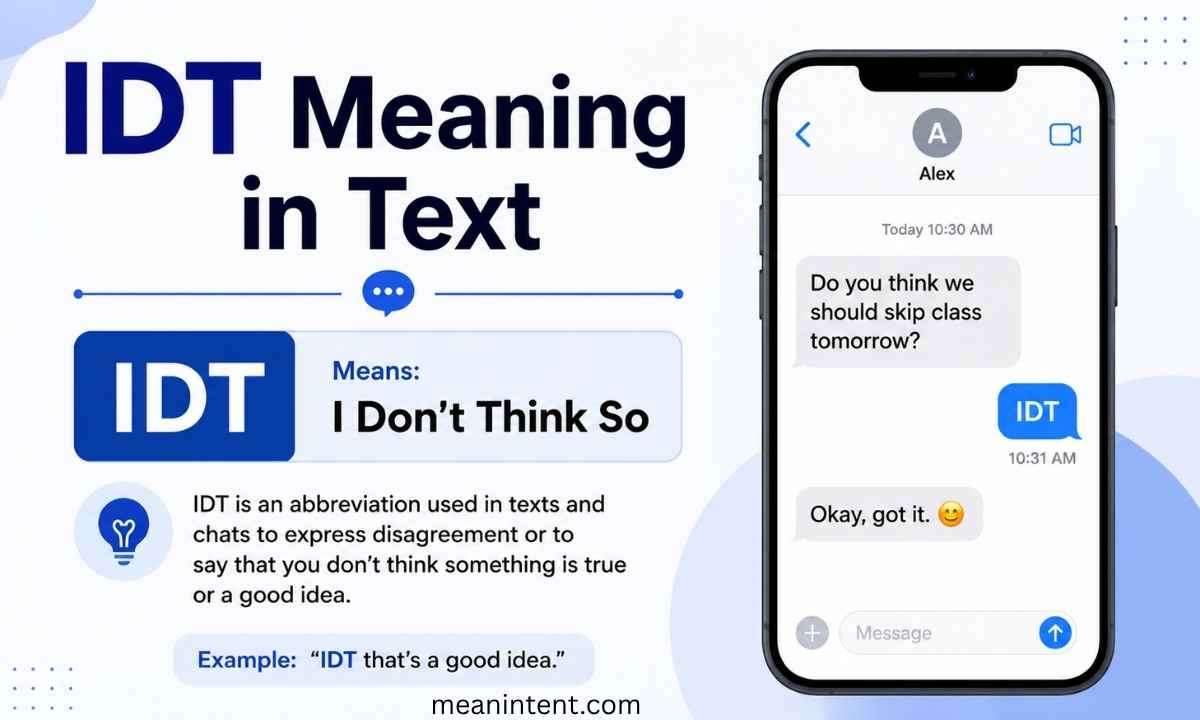
In almost every casual conversation, IDT stands for “I Don’t Think.” It’s a hedge — a way of expressing doubt, disagreement, or a personal opinion without sounding blunt.
Instead of typing out “I don’t think that’s a good idea,” someone types “idt that’s a good idea.” Same meaning, fewer keystrokes, softer delivery.
IDT belongs to a broader family of texting shorthand built for speed. Here’s where it shows up most often:
| Where You’ll See It | Typical Use |
| Group chats and one-on-one texting | Sharing a quick opinion or doubt with friends |
| Comment sections on TikTok and Instagram | Reacting to a video or post without writing a full sentence |
| Snapchat conversations between close friends | Fast, casual replies in disappearing chats |
| Discord servers and gaming lobbies | Signaling doubt to teammates without breaking the flow |
Every Meaning of “IDT” — Ranked by How Often People Actually Use It
IDT isn’t a one-definition abbreviation. The letters stay the same, but the exact shade of meaning shifts depending on how confident, firm, or casual the sender wants to sound. Here’s a breakdown from most common to least common.
“I Don’t Think” — The Everyday Default
This is the version you’ll see roughly nine times out of ten. It’s neutral, conversational, and doesn’t carry much emotional weight on its own. Example: “idt we have practice tomorrow.”
“I Don’t Think So” — The Polite Pushback
Sometimes IDT is shorthand for the full phrase “I don’t think so,” used as a standalone answer to a yes/no question. It’s slightly more final than the bare hedge but still softer than a flat “no.”
Low Confidence / Tentative Agreement
Occasionally, IDT is paired with a qualifier to show partial agreement laced with doubt — “idt so, but I could be wrong.” This version signals openness to being corrected.
Rare and Regional Alternate Meanings
Outside casual chat, IDT can stand for other things entirely — Idle Detection Time, Indirect Tax, or Inactive Duty Training, for example. These meanings rarely appear in personal texting.
How “IDT” Shows Up Across Different Platforms? — And Why It Shifts
The letters never change, but the vibe absolutely does. Context — who’s talking, where, and how fast — reshapes what IDT feels like to the person reading it.
Texting and iMessage — The Natural Habitat
This is where IDT feels most at home. Because texting usually happens between people who already know each other, the tone reads as sincere and low-stakes. “idt that restaurant is worth the drive” comes across as a casual opinion, not a jab.
TikTok and Instagram Comments — Where It Gets Misread Most
Comment sections strip away tone entirely. There’s no shared history, no inside jokes, no facial expression to soften the words. A stranger’s “idt” on a comment thread can land colder than the same message from a friend. Creators have started using it in captions almost ironically — a shorthand way of admitting uncertainty out loud.
Snapchat — The Ephemeral Context Problem
Snapchat messages often disappear after being read, which creates a unique wrinkle: if you misread an “idt” and the snap is gone, you’re left guessing at tone with no way to double-check. That’s part of why Snapchat users frequently follow up a bare “idt” with a clarifying line or emoji.
Discord and Gaming Communities
In gaming chat, IDT functions like a fast strategy call. It tells teammates “I have doubts, adjust accordingly” without breaking the flow of a match. There’s rarely any emotional subtext here — it’s purely functional.
Dating Apps — The Flirty Gray Zone
On dating apps, “idt” can carry a teasing undertone, especially when paired with a compliment or a playful challenge: “idt you could actually beat me at that.” Context and emoji do most of the heavy lifting here.
“idt I’m free Saturday”
This is one of the most common real-world examples, and it’s a good test case for how neutral IDT usually is. It’s not a rejection — it’s an honest “probably not, but let me check” wrapped in five characters.
Slack, Teams, and Workplace Chat
In workplace messaging apps, IDT still shows up, but it reads more casually than most professional communication typically allows. It’s fine between coworkers who chat informally; it’s risky in a message meant for leadership or clients.
IDT Meaning in School

Among students, IDT usually keeps its everyday meaning — expressing doubt about an assignment, a test answer, or a plan (“idt the homework’s due today”). It’s simply faster than typing a full sentence between classes.
IDT Meaning in Business
In formal business or technical contexts, IDT can stand for terms like Indirect Tax, Integrated Development and Testing, or company-specific abbreviations. These meanings are unrelated to the texting slang and depend entirely on the document or industry you’re reading.
Is “IDT” Rude, Flirty, or Just Chill? Decoding the Tone
The same three letters can feel completely different depending on who sends them and how. Here’s how to read the tone behind an “idt” instead of guessing.
The Neutral Zone — Default IDT Usage
Most of the time, IDT is simply a mild opinion marker—no hidden agenda, no attitude — just a quick, hedged thought.
When It Reads Cold or Dismissive
Tone trouble usually comes from brevity, not the abbreviation itself. A one-word “idt.” with no punctuation or follow-up can feel abrupt, especially from someone you don’t know well.
The Soft Disagreement Signal
IDT sits in a comfortable middle ground — less harsh than a flat “no,” but clearer than staying silent. That’s exactly why it has become so popular for disagreeing without conflict.
The Flirty Use — Real or Overhyped?
It can carry a playful edge in the right context (dating apps, close friends, teasing banter), but the flirtiness comes from the relationship and surrounding words, not from the letters themselves.
The Passive-Aggressive Version Nobody Talks About
When IDT is used repeatedly to shut down someone’s ideas without explanation, it can start to feel dismissive over time — less about genuine doubt, more about ending a conversation quickly.
How to Reply to “IDT”?— Without Overthinking It
Getting an “IDT” doesn’t have to leave you stuck on how to respond. Here are simple replies for whatever direction the conversation needs to go.
When You Agree With Their Doubt
“Yeah, same energy, probably not happening.”
When You Disagree and Want to Push Back
“Really? I actually think it could work — why not?”
When You Need More Information First
“What makes you say that?”
Funny and Playful Replies
“Bold of you to doubt me right now “
Professional Replies When IDT Shows Up in Work Chat
“Got it — can you walk me through your concern so we can sort it before the deadline?”
The Misreadings That Cause the Most Confusion
| Common Mix-Up | What People Assume | What’s Actually True |
| IDT vs. IDK | Both mean the same thing | IDK is “I don’t know” (missing info); IDT is “I don’t think” (an opinion) |
| Tone | It’s rude or cold | It’s usually just a short, honest opinion with no attitude behind it |
| Finality | It’s a final “no” | It’s a hedge, not a verdict — the conversation is often still open |
| Who uses it | Only teenagers | It’s now used across age groups in casual texting |
Confusing “IDT” With “IDK” — The Most Common Mix-Up
IDK means “I Don’t Know” — a statement of missing information. IDT means “I Don’t Think” — a statement of opinion or doubt. They look similar at a glance but serve entirely different purposes.
Reading It as Rude When It Isn’t
Without vocal tone or facial expression, short replies can feel harsher than intended. Nine times out of ten, IDT is just an honest, low-drama opinion.
Assuming It’s a Final Answer
IDT is a hedge, not a verdict. It usually leaves room for more conversation, not a hard stop.
Thinking Only Teenagers Use It
While it’s popular with younger users, IDT shows up across age groups now, largely because texting shorthand has become mainstream rather than niche.
Slang That Lives in the Same Neighborhood as “IDT”
| Category | Examples | What It Signals |
| Hedging and Uncertainty | IDK (“I don’t know”), IIRC (“if I recall correctly”), TBH (“to be honest”) | Softens a statement the same way IDT does |
| Soft Disagreement | “idk about that,” “eh, maybe not” | Doubt expressed gently instead of bluntly |
| Agreement With Built-In Doubt | “idt so, but maybe,” “probably not tho” | Agreement paired with hesitation, like a qualified version of IDT |
IDT Meaning Medical
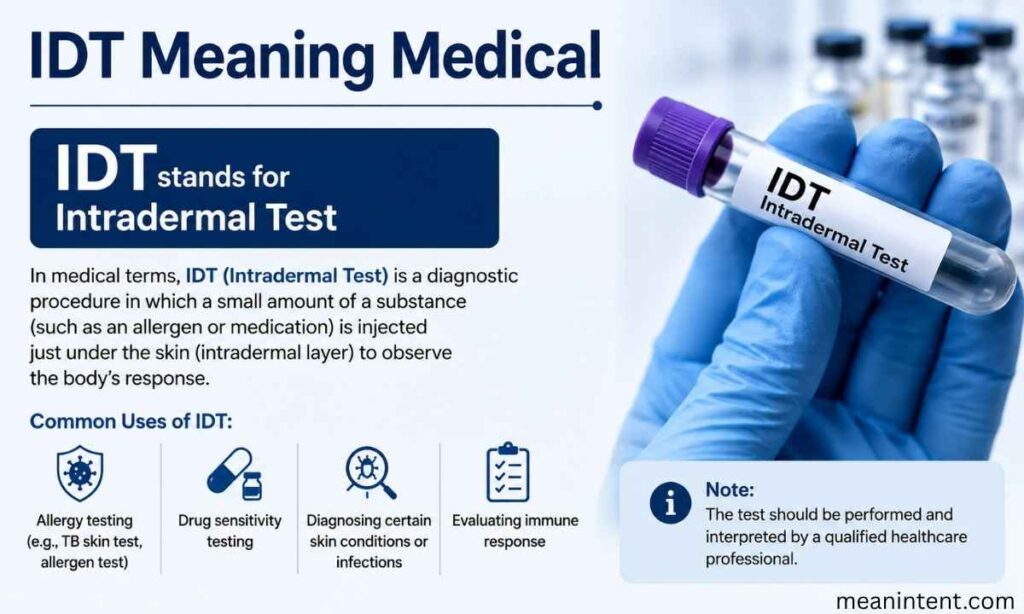
In healthcare settings, IDT typically refers to an Interdisciplinary Team — a group of doctors, nurses, therapists, and other specialists who collaborate on a patient’s care plan. This has nothing to do with texting slang.
IDT Meaning Urban Dictionary
Crowdsourced slang dictionaries generally confirm the same core definition used across social platforms: “I Don’t Think,” with user-submitted examples showing it in casual disagreement and opinion-sharing contexts.
IDT Meaning Army

In military and defense contexts, IDT commonly refers to Inactive Duty Training — scheduled training periods for reserve service members. Again, this is a completely separate meaning from the texting version.
Situations Where “IDT” Will Get You in Trouble
IDT works well in casual settings, but not every conversation is casual. Here are the moments where reaching for this shorthand can backfire.
Professional Emails and Formal Reports
Slang abbreviations read as unpolished in formal writing. “I don’t believe this approach will work” is always the safer choice over “idt this works.”
High-Stakes Personal Conversations
When a conversation carries real emotional weight — an apology, a serious decision, a difficult topic — a bare “idt” can feel dismissive even if that’s not the intent. Full sentences carry more care.
Cross-Cultural and International Communication
Not everyone recognizes texting shorthand the same way, and abbreviations can translate awkwardly or get lost entirely for non-native speakers.
When Someone Needs a Clear Yes or No
IDT is inherently hedged. If someone genuinely needs a firm decision, a vague “idt” can create more back-and-forth than it saves.
Case Study: How “IDT” Changed the Tone of a Whole Conversation?
A group of coworkers planning a client dinner hit friction after one person replied “idt” to a proposed restaurant with nothing else attached. The group read it as a flat rejection and moved on. It later turned out the sender simply had a dietary concern — a detail lost because the message was too short to carry it. The fix: one clarifying sentence after a hedge like IDT prevents most misunderstandings before they start.
Frequently Asked Questions
What does IDT mean in a text message?
It usually means “I Don’t Think,” used to express doubt or a soft opinion.
Is IDT the same as IDK?
No. IDK means “I don’t know,” while IDT means “I don’t think” — one is about missing information, the other is about opinion.
Is IDT rude?
Not inherently. It can feel blunt without context, but it’s generally a polite way to disagree.
Can IDT be flirty?
Yes, in the right setting — like dating apps or close friendships — it can carry a playful, teasing tone.
Is it okay to use IDT at work?
It’s fine in casual coworker chats, but it’s best avoided in formal emails or client-facing messages.
What does IDT mean on Snapchat?
Same core meaning as everywhere else — “I don’t think” — often used in quick, disappearing replies.
Does IDT always mean disagreement?
Not always. It can also express uncertainty or a tentative opinion rather than outright disagreement.
Conclusion
IDT is one of those small abbreviations that carries more nuance than its three letters suggest. In almost every everyday context, it simply means “I Don’t Think” — a quick, low-pressure way to share doubt or opinion. The tone around it depends far more on the platform, the relationship, and the surrounding words than on the abbreviation itself. Once you know that, decoding it in any chat — Snapchat, TikTok, Instagram, or your family group text — becomes second nature.

John Marvel is a passionate writer with 4 years of experience exploring words and ideas. He runs an engaging blog focused on the meaning niche, where he dives deep into the origins, interpretations, and insights behind everyday terms. John loves making complex concepts simple and interesting for his readers. His curiosity drives him to uncover hidden stories and meanings that spark thought and conversation.