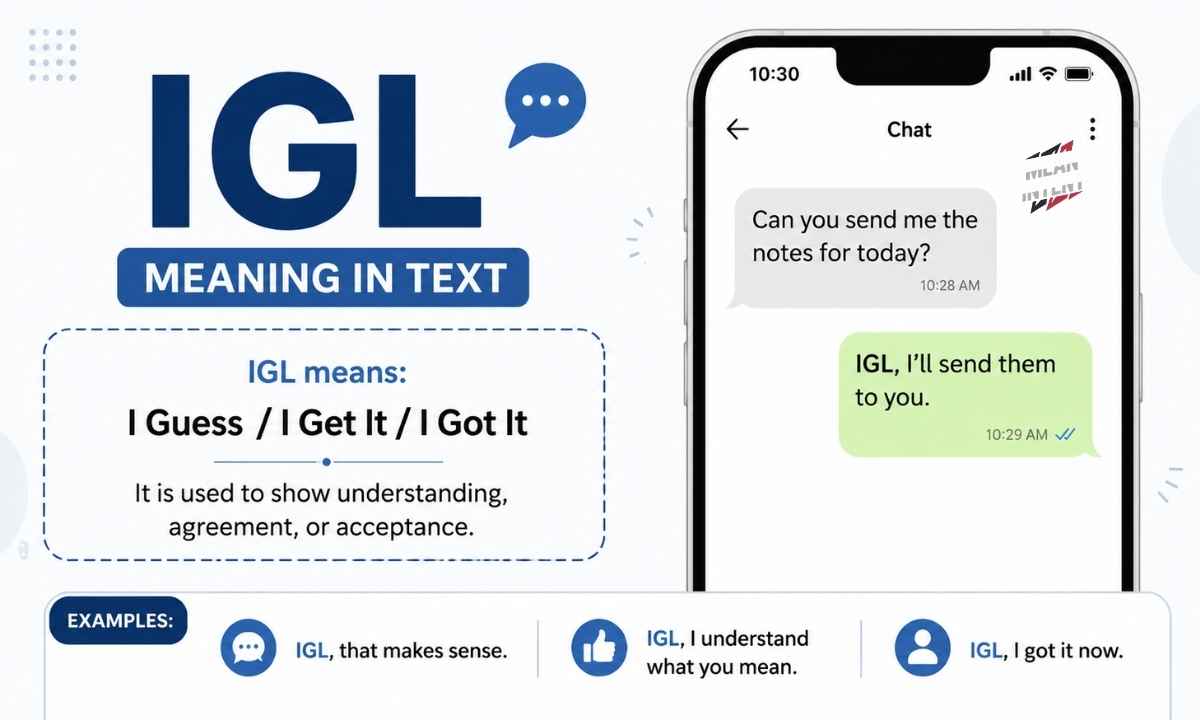
If you’ve spent any time in gaming Discords, Valorant lobbies, or esports Twitter, you’ve probably seen the letters IGL thrown around. It shows up in chat, in match commentary, and increasingly in group chats that have nothing to do with gaming at all. This guide breaks down exactly what IGL means, where it came from, and how people use it today.
What Does IGL Mean?
IGL is one of those acronyms you’ll see constantly in gaming chat but rarely see spelled out. It refers to the player who takes charge of a team’s strategy while a match is actually happening — calling plays, directing teammates, and adjusting the game plan on the fly. The term started in competitive shooters but has since spread across genres and even outside gaming entirely, so seeing it in a random group chat doesn’t necessarily mean anyone’s talking about video games.
Acronym Breakdown
IGL stands for In-Game Leader. Each letter maps directly to the phrase:
- I — In
- G — Game
- L — Leader
Origin and History of IGL
Like most gaming slang, IGL didn’t appear overnight — it evolved alongside competitive play itself, gradually shifting from a niche strategy term into everyday chat language.
Early Gaming Roots
The term IGL originated in team-based competitive gaming, particularly in early Counter-Strike. As teams became more structured and competitive play matured, squads realized they needed someone dedicated to calling strategy rather than just focusing on their own kills. That role eventually got its own label.
Expansion into Other Games
As esports grew beyond Counter-Strike, the IGL concept spread to other team-based titles — Valorant, Overwatch, Rainbow Six Siege, and various MOBA and battle royale formats with squad play. Each game adapted the role slightly, but the core idea stayed the same: one player directs the team’s in-match decisions.
| Game | What the IGL Typically Manages |
| Counter-Strike | Buy rounds, executes, map control |
| Valorant | Site executes, utility usage, agent comps |
| Overwatch | Team fight timing, ultimate coordination |
| Rainbow Six Siege | Site reads, defender/attacker setups |
| MOBAs (squad play) | Objective timing, rotations, team fights |
| Battle Royale (squads) | Rotations, circle positioning, fight decisions |
Move into Mainstream Digital Language
Over time, IGL escaped the boundaries of hardcore esports terminology and crept into everyday gaming chat, then into meme culture, and eventually into general internet slang. Today it’s used loosely to describe anyone who takes charge of a group — gaming or not.
IGL Meaning in Chat
In general gaming chat, IGL usually refers to whoever is directing the team’s strategy in that specific match or session. It can be used seriously (“who’s IGL this round?”) or as a lighthearted label for the friend who always ends up organizing the group.
IGL Meaning in Valorant
In Valorant, the IGL is the player who calls executes, decides which site to hit, manages utility usage, and adjusts strategy based on the enemy’s tendencies. Valorant’s structured round format (with buy phases, agent abilities, and site executes) makes the IGL role especially important — arguably as important as it is in Counter-Strike.
IGL Meaning Urban Dictionary
Informal definitions of IGL on sites like Urban Dictionary generally track the same core meaning — “in-game leader” — but with more emphasis on personality. Casual definitions often describe the IGL as the person who’s bossy, opinionated, or “always right (according to them),” reflecting how the term gets used jokingly among friends.
IGL Meaning in Fortnite
In Fortnite, especially in duos and squads competitive play, IGL refers to the player who calls rotations, decides when to push fights, and manages positioning relative to the storm circle. Because Fortnite matches move fast and circles shrink quickly, the Fortnite IGL often has to make split-second calls with less room for error than in tactical shooters.
Why the IGL Role Matters So Much?
The difference between a team with a strong IGL and one without often shows up less in individual skill and more in how well the group functions together under pressure.
Without an IGL:
- Players make individual decisions that don’t align
- Rotations get missed or duplicated
- Strategy defaults to whoever shouts loudest in the moment
- Teams struggle to adapt mid-match
With a Strong IGL:
- The team executes cohesive strategies
- Calls are made quickly, reducing hesitation
- Players can focus on mechanics instead of decision-making
- Adjustments happen smoothly between rounds or engagements
The Psychological Dimension
Being an IGL isn’t just about game knowledge — it’s about managing people. A good IGL keeps morale up after a bad round, defuses tilt, and gets teammates to trust calls even when they disagree. This is often the hardest part of the role, and it’s why not every skilled player makes a good IGL.
Types of IGLs in Competitive Gaming
Not every IGL leads the same way — different players bring different styles to the role, shaped by their personality, experience, and how their team prefers to play.
The Main IGL
The primary shot-caller, responsible for the majority of strategic decisions.
The Secondary IGL
A backup caller who can step in if the main IGL is unavailable or overwhelmed, or who takes over specific phases of the game.
The Tactical IGL
Focuses heavily on structured setups, timing, and utility usage — highly systematic in approach.
The Aggressive IGL
Favors fast, high-risk plays designed to pressure opponents and take early initiative.
The Passive IGL
Prefers information-gathering and calculated, low-risk decisions, often playing for map control before committing.
The Natural IGL
Someone who falls into the leadership role organically, without formal training, simply because their calls tend to work.
The Experienced IGL
A veteran player whose calls are shaped by years of matches, giving them a deep library of reads and counters.
The Meme IGL
Used jokingly in casual play or friend groups — the “IGL” who calls chaotic, often unserious strategies for laughs.
What Makes a Great IGL?
Beyond just calling plays, the best IGLs combine sharp game sense with soft skills that keep a team functioning smoothly under pressure.
Game Knowledge
Deep understanding of maps, timings, agent/character kits, and meta trends.
Communication Under Pressure
Clear, concise calls — even when the situation is chaotic or the round is slipping away.
Adaptability
The ability to scrap a plan mid-execution and pivot when it’s not working.
Decision Speed
Competitive rounds often leave only seconds to decide; hesitation costs rounds.
Ego Management
Balancing confidence with openness to input from teammates, without letting pride override good calls.
Trust Building
Getting teammates to buy into calls, especially unconventional ones, because they believe in the IGL’s judgment.
IGL in Professional Esports
At the professional level, the IGL role is often a defined position on the roster, similar to a captain in traditional sports. Some pro IGLs are known more for their leadership and strategic mind than their raw mechanical skill, and organizations specifically scout and value this trait separately from aim or reflexes. Commentary and analysis in pro esports frequently credit or blame the IGL directly for a team’s strategic performance, separate from individual player stats.
What does IGL Mean in Snapchat?
On Snapchat, IGL is typically used the same way as in gaming chat — referring to whoever is “leading” a group activity, plan, or Snap group, often as a joke rather than a literal esports reference.
What does IGL mean on Instagram?
On Instagram, especially in comments or captions on gaming content, IGL is used to tag or praise whoever is seen directing a team or squad in a clip. It’s also sometimes used self-referentially in bios or captions by people who enjoy organizing their friend group.
IGL Beyond Gaming: Real-World Usage
Because the core idea — one person stepping up to lead a group’s decisions — isn’t unique to gaming, IGL has naturally found a home in plenty of non-gaming contexts too.
Friend Group Planning
The friend who always decides where everyone’s eating or what the group is doing that night gets jokingly called the IGL.
Work and Team Contexts
Some people borrow the term informally for whoever ends up directing a project or meeting, even outside gaming circles.
Social Media Content
Creators use IGL as a tag or caption on clips showing someone making a decisive, well-timed call.
Everyday Group Dynamics
Anywhere a group needs one person to make the final call — planning a trip, splitting a bill, picking a movie — someone might get labeled the IGL.
Real Conversation Examples of IGL
Example 1: Gaming Session
“Who’s IGL this game? I don’t want to call it; I’m tired.”
Example 2: Post-Match Analysis
“Our IGL made the right read on that last round, switched us to B with 10 seconds left.”
Example 3: Casual Friend Group
“Bro is the IGL of this group chat, always deciding where we eat.”
Example 4: Social Media Comment
“That IGL call was insane, how did they read that push?”
Example 5: Humorous Use
“Nobody asked you to be IGL of the group project lol.”
Example 6: Work Context
“She’s basically the IGL of our team standups at this point.”
Example 7: Tournament Discussion
“Their IGL has been the difference maker all season.”
Example 8: Team Recruitment
“We need a solid IGL before we can compete seriously; mechanics alone won’t cut it.”
IGL vs Similar Gaming Roles: Full Comparison
| Role | Primary Focus | Decision Scope |
| IGL (In-Game Leader) | Overall strategy and calls | Whole-team, real-time |
| Captain | Leadership and representation | Team culture, sometimes overlaps with IGL |
| Entry Fragger | First contact/engagement | Individual execution |
| Support | Utility and setup for teammates | Individual, reactive |
| Coach | Strategy prep and review | Pre/post-match, not live calling |
| Analyst | Data and opponent tendencies | Preparation phase |
The key distinction: the IGL calls the shots live, during the match, while roles like coach and analyst operate mostly outside active gameplay.
Gen Z and IGL: Usage in 2026
By 2026, IGL has fully crossed over into general internet slang, used well beyond esports to describe anyone taking charge in a group setting — often with a joking or exaggerated tone. It’s become shorthand for “the decisive one” or “the one who actually makes the plan happen,” used across gaming chat, group texts, and social captions alike.
| Context | How Gen Z Uses IGL |
| Gaming Chat | Original, literal use — the player calling strategy |
| Group Texts | The friend who plans and organizes everything |
| Social Captions | Tagging whoever made the decisive call in a clip |
| School/Group Projects | Jokingly labeling whoever takes charge |
| Everyday Banter | Shorthand for “the decisive one” in any situation |
When to Use IGL and When to Avoid It
Like most slang, IGL works well in the right setting but can fall flat or confuse people in the wrong one — so it helps to know when it actually fits.
Use IGL When:
- Talking about competitive or casual team-based gaming
- Referring to someone making real-time strategic calls
- Joking about a friend who organizes the group
Avoid IGL When:
- Writing in formal or professional communication
- The audience isn’t familiar with gaming slang
- A clearer term (like “leader,” “organizer,” or “captain“) would communicate better
Common Mistakes People Make with IGL
Even people who use IGL regularly sometimes misunderstand what the role actually involves, leading to a few recurring misconceptions.
Mistake 1: Confusing IGL with the Best Player
The IGL isn’t automatically the most mechanically skilled player; leadership and mechanical skill are separate strengths.
Mistake 2: Thinking the IGL Always Wins Arguments
Being IGL means making the final call, not being right every time. Good IGLs still get overruled or proven wrong.
Mistake 3: Using IGL in Formal Professional Settings
Because it’s gaming slang, using IGL in workplace emails or formal writing can come across as unclear or overly casual.
Mistake 4: Assuming Every Team Needs One Single Fixed IGL
Some teams rotate calling duties or split responsibilities between two players depending on the situation, rather than relying on one fixed IGL.
Quick Reference Summary
- IGL = In-Game Leader
- Originated in Counter-Strike, spread to Valorant, Fortnite, and other team games
- Refers to the player who calls strategy and shots during a match
- Now used casually online to describe anyone who “leads” a group, gaming or not
- Different from coach, captain, or analyst — the IGL calls live, in real time
| Aspect | Summary |
| Full Form | In-Game Leader |
| Origin | Counter-Strike |
| Spread To | Valorant, Fortnite, Overwatch, and other team games |
| Core Function | Calls strategy and shots during a live match |
| Casual Usage | Describes anyone who “leads” a group, gaming or not |
| Distinct From | Coach, captain, analyst — IGL calls happen live, in real time |
Frequently Asked Questions
Does every gaming team have an IGL?
Not always. Casual or solo-queue teams often don’t have a designated one, but organized and competitive teams almost always do.
Can the IGL also be the best player?
Yes, sometimes — but it’s not required. Many top IGLs are valued specifically for leadership rather than top individual stats.
Is IGL used outside of gaming?
Increasingly, yes. It’s become general slang for whoever leads or organizes a group, gaming-related or not.
What’s the difference between an IGL and a captain?
An IGL specifically makes live, in-match strategic calls. A captain’s role can be broader, covering team culture and off-match leadership, and sometimes overlaps with the IGL role.
Conclusion
IGL started as a specific esports term — In-Game Leader — describing the player responsible for calling strategy during a match. Over time, it grew from Counter-Strike lingo into a term used across Valorant, Fortnite, and other competitive games, and eventually into everyday internet slang for anyone who takes charge of a group. Whether you see it in a Valorant match chat or in a group text about dinner plans, the meaning stays rooted in the same idea: someone stepping up to make the call.

John Marvel is a passionate writer with 4 years of experience exploring words and ideas. He runs an engaging blog focused on the meaning niche, where he dives deep into the origins, interpretations, and insights behind everyday terms. John loves making complex concepts simple and interesting for his readers. His curiosity drives him to uncover hidden stories and meanings that spark thought and conversation.