Scrolling through a group chat and someone drops “ion even care” out of nowhere? You’re not alone. ION is one of those tiny text abbreviations that shows up everywhere — Instagram comments, TikTok captions, Snapchat streaks, even work Slack channels when someone’s feeling extra casual. Yet most people either guess wrong or just skip past it, hoping context fills in the blanks.
This guide breaks down every real meaning of ION, where it came from, how it’s used on different apps, and when you should (and shouldn’t) type it yourself. By the end, you’ll never have to guess again.
What Does ION Mean in Text?
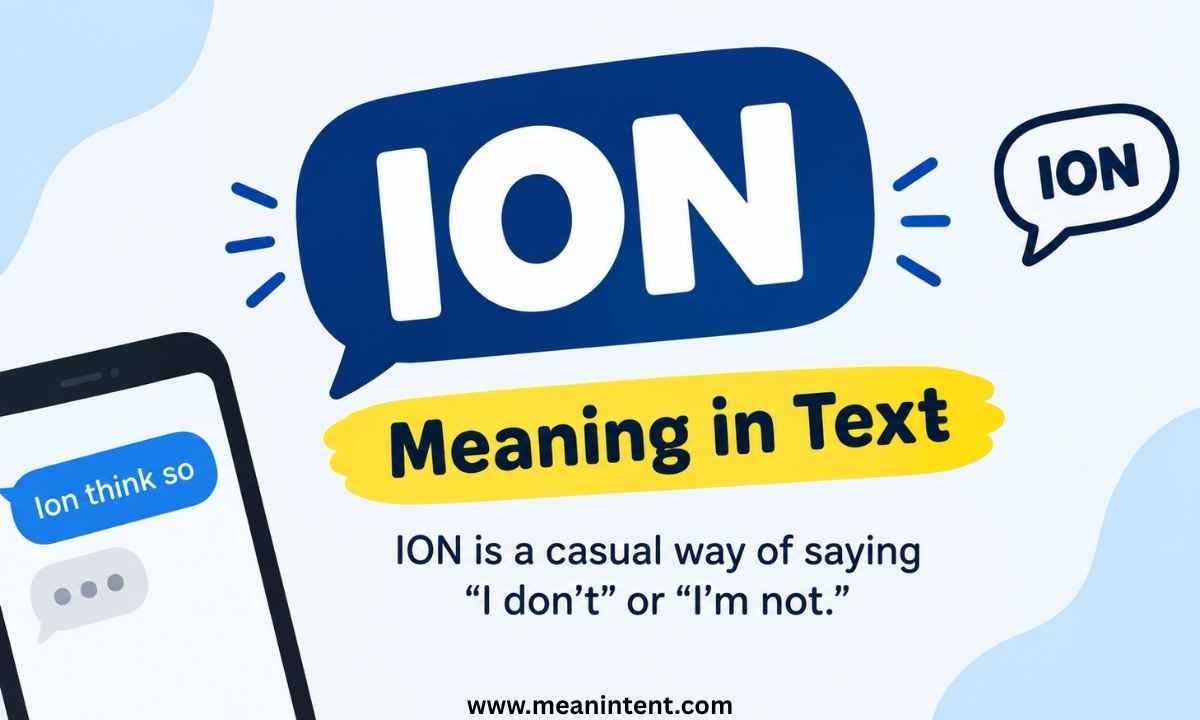
At its core, ION is a phonetic shorthand for “I don’t.” When people talk fast, “I don’t” often blends and sounds like “ion” — so texters simply typed it the way it sounds. Over time, the abbreviation stuck and became its own piece of internet slang.
That said, ION isn’t a one-trick term. Depending on the sentence, platform, or crowd you’re chatting with, it can also stand in for a couple of other phrases. The trick is reading the rest of the message to figure out which version applies.
ION Most Common Meanings at a Glance
Here’s a quick-reference table so you can decode ION in seconds:
| Meaning | Example Usage | Common Platforms |
| I Don’t | “ion know why he did that” | Texting, Instagram, TikTok |
| I Don’t Know | “ion, ask someone else” | Snapchat, group chats |
| I Don’t Care | “Ion, do whatever you want” | Texting, Twitter/X |
| In Other News | “ion, did you see the game?” | Instagram captions, TikTok comments |
| Ion (chemistry term) | “The ion has a negative charge” | Science class, textbooks |
ION Meaning — “I Don’t”
The most widespread use of ION is simply a contraction of “I don’t.” Texters drop the “d” sound and mash the words together the way they’d naturally say it out loud.
Examples:
- “ion really feel like going out tonight.”
- “ion think that’s a good idea.”
- “ion even know what happened.”
Notice that ION almost always gets paired with another verb right after it — know, think, care, feel, want. That pairing is your biggest clue that someone means “I don’t” rather than one of the other definitions.
Where Did ION Come From?
| Factor | How It Shaped ION |
| Origin | African-American Vernacular English (AAVE), where “I don’t” is naturally pronounced as one smooth sound |
| Cultural Spread | Carried into mainstream internet culture through hip-hop lyrics, Vine, and later TikTok |
| Why It Stuck | Saves time to type and sounds natural when read aloud |
| Who Adopted It | Gen Z texters, who spread it quickly across social platforms |
| When It Took Off | Early 2020s, alongside the broader rise of short-form video slang |
ION Meaning Urban Dictionary
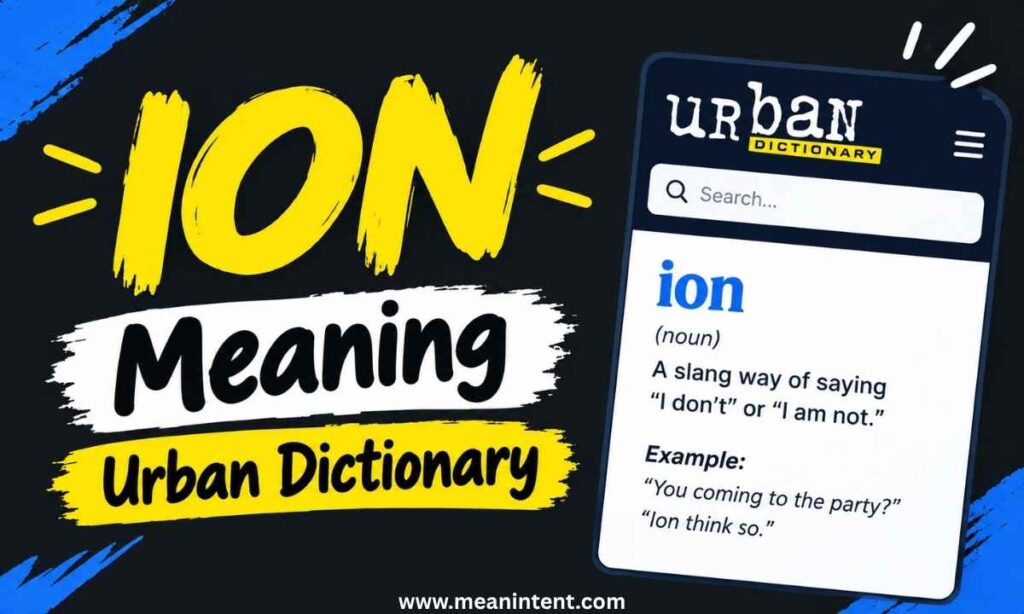
Crowdsourced slang dictionaries generally agree on the core definition: ION stands for “I don’t,” with secondary listings for “I don’t know” and “I don’t care.” Some entries also note playful or sarcastic uses, where someone types ION before saying something clearly untrue for comedic effect — similar to using “not” as a punchline at the end of a sentence.
ION Slang Pronunciation
Say it like the chemistry word “ion” — EYE-on — but said quickly, it blends into something closer to “I don’t.” Try saying “I don’t know” fast a few times; you’ll notice how naturally it collapses into that two-syllable sound. That’s exactly how the slang term was born.
What Does ION Mean in Text on Instagram?
On Instagram, ION shows up most often in comments and captions, usually to react casually to a post.
- Comment: “ion know why this isn’t viral yet 😭”
- Caption: “ion care what anyone thinks, this fit was fire”
It’s rarely used in DMs for formal conversations but pops up constantly in casual replies and story reactions.
ION Meaning in WhatsApp
WhatsApp conversations tend to be more personal, one-on-one, or small-group based, so ION shows up in a slightly softer, more sincere way compared to public platforms like TikTok or Instagram.
Example:
- “ion wanna go tbh, can we reschedule?”
Since WhatsApp is used globally and includes people of all ages, it’s smart to gauge the other person’s texting style before assuming they’ll understand ION.
What Does ION Mean on Snapchat?
Snapchat conversations are fast, casual, and disappear quickly — the perfect environment for shorthand like ION. It’s frequently used in Snap captions or chat replies where speed matters more than full sentences.
Example:
- Snap caption: “ion even know how I ended up here 💀”
Given Snapchat’s youth-heavy user base, ION is extremely common and rarely needs explanation in that context.
What Does ION Mean in Chemistry?
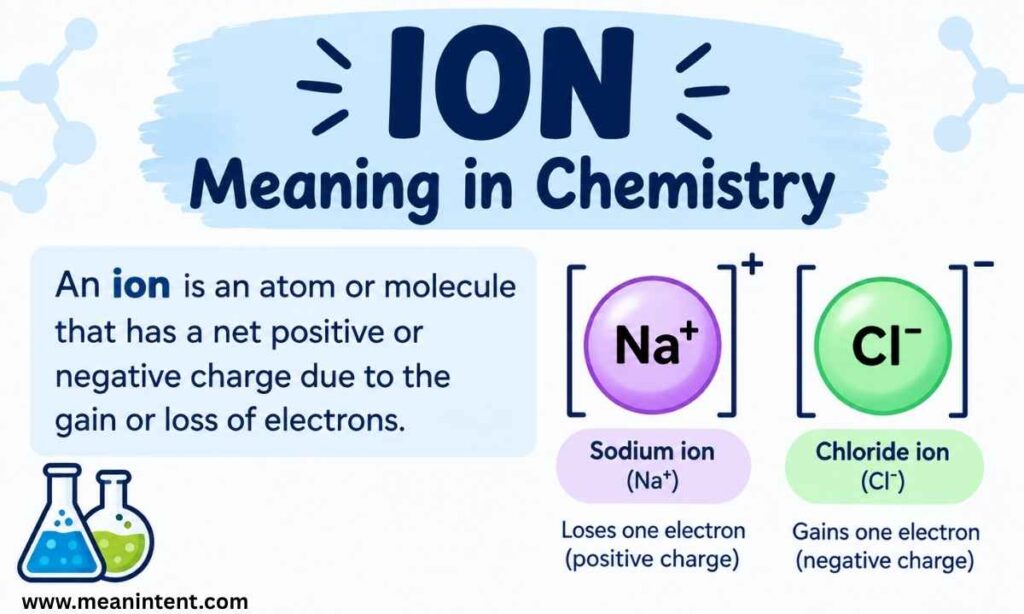
Outside of texting slang, “ion” has a completely different and much older meaning. In chemistry, an ion is an atom or molecule that carries an electrical charge because it has gained or lost one or more electrons.
- A cation is a positively charged ion (it lost electrons).
- An anion is a negatively charged ion (it gained electrons).
Ions play a critical role in everything from battery function to nerve signals in the human body. If you see “ion” in a science textbook, homework question, or lab report, it almost certainly refers to this chemistry definition — not the texting slang.
ION Meaning — “In Other News”
A secondary, less common use of ION is as an abbreviation for “In Other News.” This version usually appears when someone wants to switch topics inside a conversation or caption.
| Aspect | Detail |
| Meaning | “In Other News” |
| When It’s Used | To switch topics mid-conversation or caption |
| Example 1 | “ion, did anyone else see that storm last night?” |
| Example 2 | “ion, I finally finished the project 🎉” |
| How to Tell It Apart | If the sentence reads as a topic change rather than a personal opinion, it’s “in other news” — not “I don’t” |
How Is ION Used Across Platforms?
While the core meaning of ION stays consistent, tone and frequency shift depending on where you’re chatting:
| Platform | Typical Tone | Frequency of Use |
| Casual, comment-based | High | |
| TikTok | Trendy, often sarcastic | Very High |
| Snapchat | Quick, personal | High |
| Personal, one-on-one | Moderate | |
| Twitter/X | Opinion-driven | Moderate |
| Professional email or Slack | Not recommended | Very Low |
ION vs IDK — What Is the Difference?
Both ION and IDK feel similar, but they aren’t interchangeable in every situation.
| Term | Meaning | Flexibility |
| IDK | Always means “I don’t know” — nothing else | Fixed, single meaning |
| ION | Can mean “I don’t,” “I don’t know,” “I don’t care,” or “in other news” | Broad, context-dependent |
Think of IDK as a specific tool and ION as a flexible one. If you want zero ambiguity, IDK is the safer choice. If you want a quicker, trendier way to express uncertainty or indifference, ION fits better.
When to Use ION — And When Not To
Use ION When:
- Texting friends or peers in a casual setting
- Commenting on social media posts
- Reacting quickly in group chats
- Adding a sarcastic or dismissive tone to a message
Never Use ION In:
| Setting | Why to Avoid It |
| Professional emails or workplace messaging | Comes across as too casual or unprofessional |
| Academic papers or formal writing | Slang breaks formal tone and clarity expectations |
| Conversations with someone unfamiliar with internet slang | Risk of being misunderstood entirely |
| Customer service or business communication | Can seem dismissive or unclear to clients |
Using ION in the wrong setting can come across as unprofessional or confusing, especially with older audiences or formal contacts who may not recognize the abbreviation at all.
Frequently Asked Questions
What does ION mean in a text message?
ION most commonly means “I don’t,” used as a quick, phonetic shorthand in casual texting.
Is ION the same as IDK?
Not exactly — IDK strictly means “I don’t know,” while ION can also mean “I don’t care” or “I don’t” depending on context.
Where did the ION slang term originate?
It comes from African-American Vernacular English (AAVE), where “I don’t” is naturally pronounced as one blended sound.
Does ION mean something different in chemistry?
Yes — in chemistry, an ion is a charged atom or molecule, completely unrelated to the texting slang.
Is it okay to use ION at work?
No, it’s best avoided in professional or formal communication since it can seem too casual or be misunderstood.
Can ION mean “In Other News”?
Yes, though this use is less common and depends heavily on the sentence that follows it.
Conclusion
ION might look confusing the first time you see it, but once you know the pattern, it’s easy to spot. Most of the time, it simply means “I don’t” — whether that’s “I don’t know,” “I don’t care,” or just “I don’t” followed by a verb. Less often, it might mean “in other news,” and in a science classroom, it means something else entirely.
The best way to use ION correctly is to read the full sentence around it and match it to the platform you’re on. Save it for casual chats with friends, skip it in professional settings, and you’ll never misread — or misuse — this popular slang term again.

John Marvel is a passionate writer with 4 years of experience exploring words and ideas. He runs an engaging blog focused on the meaning niche, where he dives deep into the origins, interpretations, and insights behind everyday terms. John loves making complex concepts simple and interesting for his readers. His curiosity drives him to uncover hidden stories and meanings that spark thought and conversation.