Have you ever been scrolling through a chat and felt a bit lost when someone suddenly drops a “KK” instead of a full sentence? It is one of the most common slang terms used in instant messaging today. Essentially, the KK meaning is just a more casual way of saying “okay” or “got it,” signaling that you have received the message and are in agreement with the sender.
Ever wondered if your short replies make you seem dismissive or just efficient? While some think it is rude, others see it as the ultimate digital shorthand for social media. Using two letters instead of four might seem like a tiny habit, but in the fast-paced world of online communication, every keystroke counts for efficiency.
In short, “KK” is just informal language used to acknowledge a conversation. Whether you are texting friends or commenting on a status, it serves as a quick response to keep the dialogue moving. It is a staple of modern internet culture and text-speak.
Origin of KK: Where Did It Come From?
To understand the KK meaning, we must look back at the early days of Internet Relay Chat (IRC) and gaming culture. In the late 90s and early 2000s, “K” became the shorthand for “Okay.” However, in the high-stakes environment of competitive gaming, players began doubling the letter to signify a “definite” acknowledgment or “Message Received.” This was a way to ensure the sender knew the instruction was heard without the ambiguity that a single “K” might carry—which often felt dismissive or cold.
In 2026, this has evolved into a cornerstone of asynchronous communication. Unlike a phone call, where tone provides context, text relies on semantic markers. “KK” serves as a “soft” version of “OK.” It implies a friendlier, more buoyant tone. Linguists categorize this under pragmatic markers, which are words or phrases that don’t change the literal meaning of a sentence but significantly alter its social impact. When you type “KK,” you aren’t just saying you agree; you are signaling that the interaction is positive and that there is no “textual tension” between the parties involved.
KK vs OK: Understanding the Difference
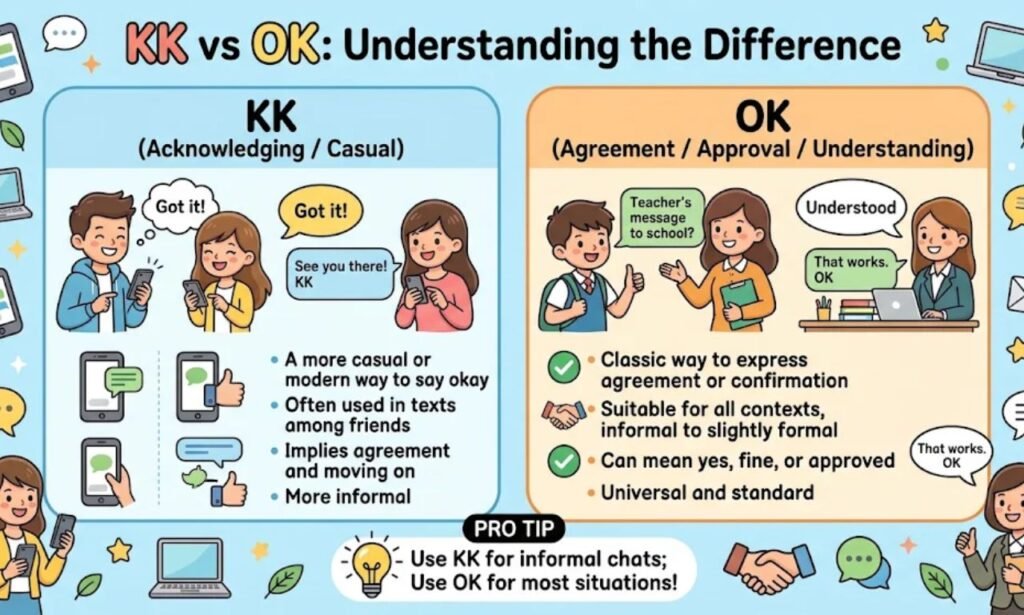
In the world of On-Page SEO and Content Strategy, understanding the user’s intent behind a search term is vital. Similarly, in a conversation, the choice between “K,” “OK,” and “KK” carries different intent signals. Using “K” can often be perceived as “passive-aggressive” or “curt,” suggesting the person is annoyed. Conversely, “OK” is the formal standard, often used in professional emails or with superiors. “KK” occupies the sweet spot of informal efficiency.
The following table organizes these variations to help you choose the right term for your digital interactions:
| Term | Formality Level | Perceived Tone | Best Use Case |
| K | Very Low | Cold/Dismissive | Quick confirmation with close friends only. |
| OK | Neutral | Professional/Direct | Business emails or formal instructions. |
| KK | Informal | Friendly/Acknowledging | Group chats, casual Slack messages, texting. |
| Okay | Moderate | Sincere/Detailed | When providing emotional support or clarity. |
This data illustrates that while the dictionary definition remains the same (affirmation), the social semantics vary wildly. As an expert in semantic content writing, I recommend matching your shorthand to the recipient’s established communication style to avoid misunderstandings.
How KK is Used in Texting and Messaging

In everyday texting, “KK” functions as a conversational “stop-gap.” It tells the other person, “I have read your message, and no further action is required from you.” This is essential for mobile communication efficiency. When someone sends a long list of groceries or a set of directions, replying with “KK” is the digital equivalent of a nod. It prevents the “double-texting” phenomenon where the sender wonders if their message was actually delivered or understood.
From a computational linguistics perspective, “KK” is often processed by Natural Language Processing (NLP) models as a “positive polarity” response. This means that AI assistants and chatbots recognize this shorthand as a successful completion of a task or an agreement to a proposal. In 2026, your smartphone’s predictive text likely suggests “KK” specifically because it has learned your informal writing style and the specific entities you interact with most frequently.
KK in Social Media Conversations
On platforms like TikTok, Instagram, and X (formerly Twitter), the KK meaning takes on a more public role. It is frequently seen in comment sections to acknowledge a point without derailing the thread. Social media is a fast-paced environment where brevity is king. Using “KK” allows users to engage with multiple content streams quickly.
For creators and brands, understanding this internet slang is crucial for community management. If a follower comments “KK” on a post, they are signaling a low-effort but positive engagement. Brands that respond with similar informal language often see higher engagement rates because they appear more “human” and less like a corporate entity. This alignment with user-generated content trends is a key strategy for maintaining brand authority in 2026.
Cultural Interpretations of KK Around the World
While “KK” originated in Western gaming and chat circles, its global footprint is fascinating. In many English-speaking countries, it is purely a text-speak staple. However, in some cultures, the repetition of letters can carry different weights. For instance, in certain East Asian digital circles, repeating letters often signifies cuteness or a “softened” tone, similar to how one might speak to a child or a pet.
Linguists studying digital anthropology note that “KK” is an example of a “globalized loan-word” in the world of code. Even people whose primary language isn’t English will use “KK” in international gaming servers or global business chats to signal universal agreement. It has become a part of a “trans-national” digital vocabulary that bypasses traditional language barriers, making it a powerful tool for cross-cultural communication.
When KK Can Be Seen as Polite or Rude
The perception of “KK” depends entirely on contextual relevance. It is seen as polite when used to save the other person’s time. For example, if someone is driving and sends a quick update, a “KK” response is perfectly acceptable and polite because it acknowledges the message without requiring the driver to read a long reply.
However, it can be perceived as rude in “high-stakes” emotional conversations. If a friend sends a heartfelt message about a difficult day, replying with “KK” feels dismissive and cold. In this semantic context, the brevity of the response suggests a lack of care. This is why digital etiquette suggests matching the “length and strength” of your response to the message you received. If the incoming message is 100 words, a 2-letter reply is likely a social error.
KK in Professional vs Casual Conversations
In a professional environment, the use of “KK” should be handled with caution. While Slack and Microsoft Teams have normalized informal communication at work, there is still a hierarchy to consider. Using “KK” with a direct report might signal a “chill” and approachable management style. However, using it with a CEO or a new client might make you appear unprofessional or uneducated in business correspondence.
As of 2026, many companies have internal “style guides” for digital chat. These guides often suggest using emojis or formal acknowledgments for official records, while reserving “KK” for quick, lateral coordination between teammates. From an on-page SEO perspective, if you are writing for a professional audience, you should define these semantic boundaries clearly to provide the most value to your readers.
Common Misunderstandings About KK
One major misunderstanding is that “KK” stands for “Kool Kay” or some other specific phrase. In reality, it is simply a reduplication of the letter “K.” Another common myth is that it is an acronym for a specific technical term. While some niche industries might have an “initialism” that uses those letters, in 99% of digital discourse, it is simply a variation of “Okay.”
Another point of confusion is the “single K” vs. “double K.” Many people don’t realize that “K” is often seen as “angry” while “KK” is seen as “happy.” This nuance is often lost on older generations who are new to instant messaging. Explaining these social cues is a vital part of providing a comprehensive guide that adds real-world depth to the topic.
Fun Facts About KK and Other Text Abbreviations
Did you know that “KK” is technically a “pro-word” in some radio communication contexts? While the internet slang version is different, the idea of using short sounds for “message received” is as old as the telegraph. Here are some interesting facts about modern shorthand:
- Longevity: “KK” has survived longer than many other 90s slang terms like “ROFLMAO.”
- Keystroke Efficiency: Typing “KK” is 50% faster than typing “Okay” on a standard QWERTY keyboard.
- Global Reach: It is one of the top 50 most used alphanumeric sequences in global SMS traffic.
- The “Vibe” Check: In 2026, “KK” is considered a “neutral-positive” marker, whereas “OK.” (with a period) is considered “aggressive.”
Alternatives to KK: Other Ways to Say “Okay”
If you find that “KK” doesn’t fit your personal writing style, there are plenty of other LSI-related terms you can use to signify agreement. Variety in your vocabulary makes you a more engaging communicator and a better content creator.
Here is a list of alternatives for different social contexts:
- “Gotcha”: Best for confirming instructions or directions.
- “Sounds good”: Ideal for making plans or agreeing to a proposal.
- “Understood”: The gold standard for professional clarity.
- “Copy that”: A slightly more formal, “radio-style” confirmation.
- “Bet”: A popular 2026 alternative used by Gen Z and Alpha for “I agree/Yes.”
- “Roger”: Used in technical or collaborative project management.
By choosing the right alternative, you ensure that your intent signals are clear and that your digital footprint reflects the tone you want to project.
Conclusion
Mastering the nuances of the KK meaning is more than just a lesson in internet slang; it is an essential skill for navigating the complex social dynamics of 2026. As we have seen, this simple alphanumeric shorthand serves as a vital bridge between efficiency and digital empathy, allowing for quick affirmation without the coldness of a single letter. Whether you are a content strategist optimizing for NLP or a casual user texting friends, understanding these semantic markers ensures your online communication remains clear, friendly, and contextually appropriate across all digital platforms.
In conclusion, the evolution of text-speak continues to reshape how we build relationships and share information in a fast-paced world. By staying informed about linguistic trends and choosing the right vocabulary for your audience, you maintain a high level of digital literacy and brand authority. As search engine algorithms and human expectations continue to favor authentic engagement, using tools like “KK” correctly will help you stay connected and understood. Embracing these informal language shifts is the key to mastering the modern digital tongue and ensuring your messages always hit the right note.

Abu Bakar is a passionate writer with 4 years of experience exploring words and ideas. He runs an engaging blog focused on the meaning niche, where he dives deep into the origins, interpretations, and insights behind everyday terms. He loves making complex concepts simple and interesting for his readers. His curiosity drives him to uncover hidden stories and meanings that spark thought and conversation.